









Langue:
Anglais


|
|
|
|
2-4
90'
14
Aucun texte nécessaire dans le jeu
|
First Monday in October
Éditeur: Fort Circle Games
 Voulez-vous vendre votre copie de ce jeu ?

Utilisez notre marché utrade !
First Monday in October
Contactez-nous
Partager sur
L'article n'est pas disponible, vous pouvez utiliser l'alerte pour être averti lorsqu'il sera de nouveau en stock.
PHOTOS SUR BGG
Ces photos sont la propriété de boardgamegeek.com et ne font pas spécifiquement référence à l'édition présentée sur cette page.






 Descriptif
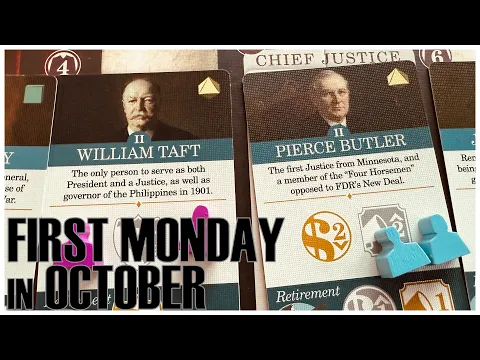
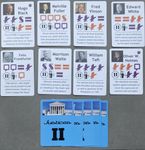
On the first Monday in October, the all-powerful Justices of the U.S. Supreme Court gather each year in their "marble palace" to decide the fate of the free world. Each player represents a long-standing institute, association, or think tank attempting to gain renown by shaping the composition of the high court, taking sides in landmark cases throughout the history of the United States, and determining the governing laws of the land. Players need to use their limited influence and actions wisely to control the judicial philosophy of the court and to prevail in as many cases as possible.
Over the course of two hours, First Monday in October — for which designer Jason Matthews was the lead developer — re-creates the history of the U.S. Supreme Court from 1789 to the present day, through three distinct eras: Era I represents the founding of the Court in 1789 until the Civil War in 1865; Era II represents 1866 until the seminal decision of Brown v. Board in 1954; and Era III represents 1955 until the present day.
The game revolves around the following four judicial philosophy tracks:
Commerce Clause: This track represents the scope of Article I, Section 8 of the U.S. Constitution, which grants Congress the power to "regulate commerce" among the several states.
Equality & Liberty: This track broadly represents the scope of individual equality and liberty, including but not limited to the 14th Amendment (i.e., equal protection, due process, and privacy rights).
Free Speech: This track represents the obligation in the 1st Amendment that Congress make no law abridging a person's freedom of speech, and the scope of permissible restrictions on that freedom.
Executive Power: This track broadly represents the scope of Article II of the U.S. Constitution, which enumerates the powers of the executive branch, including the Office of the President and law enforcement.
Shifting each philosophy one way generally represents a more expansive centralized Federalist interpretation of these constitutional provisions (consistent with a Hamilton-Madison perspective), whereas shifting each philosophy the other direction represents a more narrow decentralized Anti-Federalist application of these provisions (consistent with a Jefferson-Monroe perspective).
 Informations supplémentaires
| Mécanique: | |
| Catégories: | Politique/Négociation |
| Noms alternatifs: | |
| BARCODE: | ????????? |
| Cela a été vu 1085 fois | |
Descriptif
On the first Monday in October, the all-powerful Justices of the U.S. Supreme Court gather each year in their "marble palace" to decide the fate of the free world. Each player represents a long-standing institute, association, or think tank attempting to gain renown by shaping the composition of the high court, taking sides in landmark cases throughout the history of the United States, and determining the governing laws of the land. Players need to use their limited influence and actions wisely to control the judicial philosophy of the court and to prevail in as many cases as possible.
Over the course of two hours, First Monday in October — for which designer Jason Matthews was the lead developer — re-creates the history of the U.S. Supreme Court from 1789 to the present day, through three distinct eras: Era I represents the founding of the Court in 1789 until the Civil War in 1865; Era II represents 1866 until the seminal decision of Brown v. Board in 1954; and Era III represents 1955 until the present day.
The game revolves around the following four judicial philosophy tracks:
Commerce Clause: This track represents the scope of Article I, Section 8 of the U.S. Constitution, which grants Congress the power to "regulate commerce" among the several states.
Equality & Liberty: This track broadly represents the scope of individual equality and liberty, including but not limited to the 14th Amendment (i.e., equal protection, due process, and privacy rights).
Free Speech: This track represents the obligation in the 1st Amendment that Congress make no law abridging a person's freedom of speech, and the scope of permissible restrictions on that freedom.
Executive Power: This track broadly represents the scope of Article II of the U.S. Constitution, which enumerates the powers of the executive branch, including the Office of the President and law enforcement.
Shifting each philosophy one way generally represents a more expansive centralized Federalist interpretation of these constitutional provisions (consistent with a Hamilton-Madison perspective), whereas shifting each philosophy the other direction represents a more narrow decentralized Anti-Federalist application of these provisions (consistent with a Jefferson-Monroe perspective).
Informations supplémentaires
| Mécanique: | |
| Catégories: | Politique/Négociation |
| Noms alternatifs: | |
| BARCODE: | ????????? |
| Cela a été vu 1085 fois | |
Ce que disent les joueurs
Avis des utilisateurs uplay: Aucun avis uplay publié. Soyez le premier !
Votre avis
Les commentaires sont modérés avant publication : pas de liens, insultes ou contenus hors sujet. Les avis négatifs respectueux sont acceptés.
Connectez-vous pour donner votre avis
ATTENTION ! Ne convient pas aux enfants de moins de 3 ans. Il contient de petites pièces qui pourraient être avalées ou inhalées.