







|
|
|

1-4
180'
12
Some necessary text
|
RAN
Publisher: GMT Games

 Do you want to sell your copy of this game?

Use our marketplace utrade!
RAN
Contact us
Share on
The item is not available, you can use the alert to be notified when it will be back in stock.
PICTURES ON BGG
These photos are the property of boardgamegeek.com and do not refer specifically to the edition on this page.


 Description
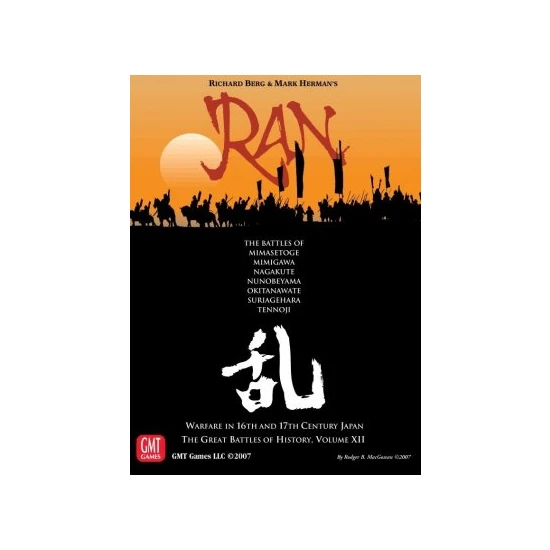
SAMURAI WARFARE IN THE SENGOKU JIDAI - 16-17th Century Japan. RAN is the 12th volume in the Great Battles of History Series, and the second game on the battles of the Samurai (following GMTs Samurai (Vol. V)). RAN covers several of the less famous battles of the Sengoku Jidai, in which powerful Daimyo - Japanese feudal lords - strove to both maintain and extend their power bases while seeking to attain the office of Shogun, the power behind the throne of the Emperor. RAN simulates the highly personal form of warfare developed by the Japanese samurai, wherein formal battles played out almost as backdrops to individual feats of courage, bravery, and devotion--much of it outstanding, some of it rather foolhardy, all of it very Homeric. Although political and tactical victory was the bottom line, collecting the severed heads of enemy samurai reigned a very close second in importance. In terms of tactics, this was, as in Europe, the Dawn of Modern Warfare, with the introduction of guns - arquebuses - by the Portuguese. Even with the revelatory effect of musketry, Japanese battles were still pretty much a swirling, non-linear affair. RAN, the name the famous Japanese film director Akira Kurosawa chose for his samurai version of King Lear, roughly means Chaos. The Battles of RAN (all battles are one-half map, except Tennoji): MIMASETOGE (6 October 1569): The Takeda try to return to their castle base, while the Hojo try to intercept and ambush them with twice their number. A startling Takeda victory. MIMIGAWA (11 November 1578): Interrupted while besieging Takajpo Castle, the Otomi retreat into the woods, then burst out to attack the Shimazu relief force, only to be outwitted by clever Shimazu tactics. NAGAKUTE (17 May 1582): Tokugawa vs Ikeda, in a nice, small battle (less than 10,000 men each). Set piece affair fought over difficult terrain--mountains, rice paddies, etc. NUNOBEYAMA (14 February 1570): The Amako vs The Mori. OKITANAWATE (24 March 1584): The Ryuzoji vs The Shimazu. SURIAGEHARA (5 June 1589): Date Masamune (and his 23,000 men) hold off an initially effective attack by Asahina Yosohiro's 16,000-man army on relatively flat terrain. Key use of reserves. TENNOJI (7 May 1615): One of the biggest battles of the era (and the only full map battle in the box). After Sekigahara, Hideyori, son of Hideysohi, challenges Tokugawa. The result is a swirling battle with over 250,000 men and many arriving reinforcements.
 Additional information
| Mechanics: | Hex-and-Counter |
| Categories: | Medieval War |
| Alternative names: | RAN 乱 RAN Ran: Warfare in 16th and 17th Century Japan 乱 |
| BARCODE: | NOEAN_889 |
| In 4 wishlists In 2 collections This was seen 8976 times | |
Description
SAMURAI WARFARE IN THE SENGOKU JIDAI - 16-17th Century Japan. RAN is the 12th volume in the Great Battles of History Series, and the second game on the battles of the Samurai (following GMTs Samurai (Vol. V)). RAN covers several of the less famous battles of the Sengoku Jidai, in which powerful Daimyo - Japanese feudal lords - strove to both maintain and extend their power bases while seeking to attain the office of Shogun, the power behind the throne of the Emperor. RAN simulates the highly personal form of warfare developed by the Japanese samurai, wherein formal battles played out almost as backdrops to individual feats of courage, bravery, and devotion--much of it outstanding, some of it rather foolhardy, all of it very Homeric. Although political and tactical victory was the bottom line, collecting the severed heads of enemy samurai reigned a very close second in importance. In terms of tactics, this was, as in Europe, the Dawn of Modern Warfare, with the introduction of guns - arquebuses - by the Portuguese. Even with the revelatory effect of musketry, Japanese battles were still pretty much a swirling, non-linear affair. RAN, the name the famous Japanese film director Akira Kurosawa chose for his samurai version of King Lear, roughly means Chaos. The Battles of RAN (all battles are one-half map, except Tennoji): MIMASETOGE (6 October 1569): The Takeda try to return to their castle base, while the Hojo try to intercept and ambush them with twice their number. A startling Takeda victory. MIMIGAWA (11 November 1578): Interrupted while besieging Takajpo Castle, the Otomi retreat into the woods, then burst out to attack the Shimazu relief force, only to be outwitted by clever Shimazu tactics. NAGAKUTE (17 May 1582): Tokugawa vs Ikeda, in a nice, small battle (less than 10,000 men each). Set piece affair fought over difficult terrain--mountains, rice paddies, etc. NUNOBEYAMA (14 February 1570): The Amako vs The Mori. OKITANAWATE (24 March 1584): The Ryuzoji vs The Shimazu. SURIAGEHARA (5 June 1589): Date Masamune (and his 23,000 men) hold off an initially effective attack by Asahina Yosohiro's 16,000-man army on relatively flat terrain. Key use of reserves. TENNOJI (7 May 1615): One of the biggest battles of the era (and the only full map battle in the box). After Sekigahara, Hideyori, son of Hideysohi, challenges Tokugawa. The result is a swirling battle with over 250,000 men and many arriving reinforcements.
Additional information
| Mechanics: | Hex-and-Counter |
| Categories: | Medieval War |
| Alternative names: | RAN 乱 RAN Ran: Warfare in 16th and 17th Century Japan 乱 |
| BARCODE: | NOEAN_889 |
| In 4 wishlists In 2 collections This was seen 8976 times | |
CAUTION! Not suitable for children under 3 years of age. It contains small parts which could be swallowed or inhaled.