









Langue:
Français
Anglais
Allemand



|
|
|
|
Idéal à 2 joueurs
225 votes sur 236
Âge conseillé par les joueurs : 8+
35 votes sur 121
2
60'
8
Kein notwendiger Text im Spiel
|
Go & Go Bang
Éditeur: Philos
 Voulez-vous vendre votre copie de ce jeu ?

Utilisez notre marché utrade !
Go & Go Bang
Contactez-nous
Partager sur
L'article n'est pas disponible, vous pouvez utiliser l'alerte pour être averti lorsqu'il sera de nouveau en stock.
PHOTOS SUR BGG
Ces photos sont la propriété de boardgamegeek.com et ne font pas spécifiquement référence à l'édition présentée sur cette page.
























 Descriptif
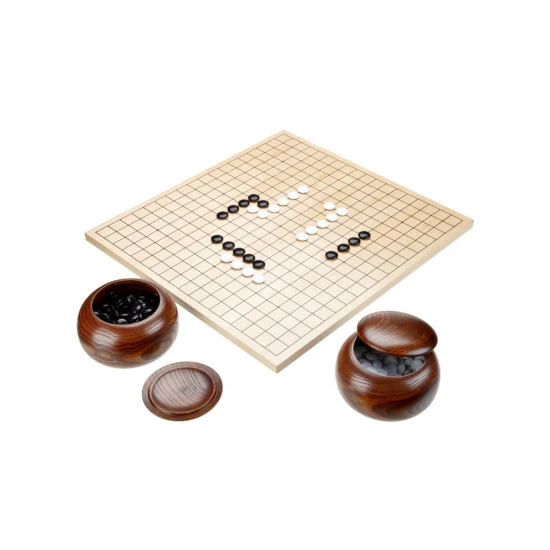
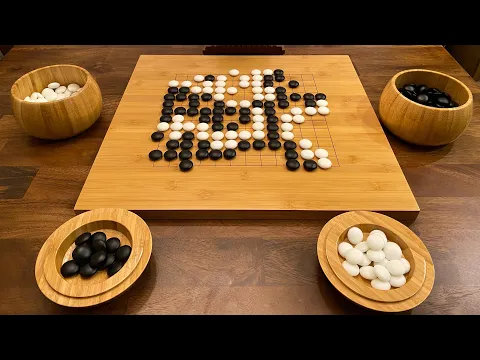
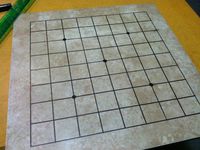
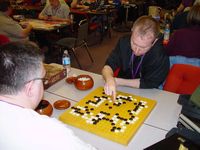
By all appearances, it's just two players taking turns laying stones on a 19×19 (or smaller) grid of intersections. But once its basic rules are understood, Go shows its staggering depth. One can see why many people say it's one of the most elegant brain-burning abstract games in history, with players trying to claim territory by walling off sections of the board and surrounding each other's stones. The game doesn't end until the board fills up, or, more often, when both players agree to end it, at which time whoever controls the most territory wins.
The earliest mention of Go (åœæ£‹ (wéi qí)- "surrounding game") appears in the "Analects" of Confucius (551-479 BC), while the earliest physical evidence is a 17×17 Go board discovered in 1952 in a tomb of the former Han dynasty (206 BC- 9 AD). There is a tangle of conflicting popular and scholarly anecdotes attributing its invention to two Chinese emperors, an imperial vassal and court astrologers. One story has it that Go was invented by the legendary Emperor Yao (ruled 2357-2256 BC) as an amusement for his idiot son. A second claims that the Emperor Shun (ruled 2255-2205 BC) created the game in hopes of improving his weak-minded son's mental prowess. A third says the person named Wu, a vassal of the Emperor Jie (ruled 1818-1766 BC), invented Go (as well as games of cards). Finally, a fourth story suggests that Go was developed by court astrologers during the Zhou dynasty (1045-255 BC).
A Go set, consisting of a very general-purpose grid and colored stones, can also be used to play a variety of other abstract strategy games, such as Connect6, Go-Moku, Pente, and others.
 Informations supplémentaires
| Mécanique: | Enceinte de zone |
| Catégories: | Stratégie |
| Noms alternatifs: | Atari Go Baduk Go Gó Go & Go Bang Turnier Go + Gobang Go und Gobang Igo NEGOCIACION Orient Original Go Paduk Patol Peg Travel Go Game Smart Go The Game of Go The Go Pack The Oriental Game of Go Wei Qi Weichi Weiqi yi yih Вэйци Го Падук 囲碁 围棋 圍棋 弈 碁 바둑 Atari Go Baduk Cờ Vây Go Go & Go Bang Turnier Go & Gobang Go + Gobang Go A Game of Oriental Strategy Go Gobang Go und Gobang Go, Das Brettspiel Ostasiens GoToGo Igo Jang Stone II Jeu de Go Magnetic Chess Magnetic GO Mikado: The Game of Go Negociation Orient Original Go Paduk Patol Peg Travel Go Game Smart Go The Game of Go The Go Pack The Oriental Game of Go Wei Qi Weichi Weiqi yi yih Yunzi Go Stone set Вэйци Го Падук 囲碁 围棋 圍棋 弈 碁 바둑 신의한수 |
| BARCODE: | 4014156032200 |
| Dans 3 listes de souhaits Dans les collections 6 Cela a été vu 18492 fois | |
Descriptif
By all appearances, it's just two players taking turns laying stones on a 19×19 (or smaller) grid of intersections. But once its basic rules are understood, Go shows its staggering depth. One can see why many people say it's one of the most elegant brain-burning abstract games in history, with players trying to claim territory by walling off sections of the board and surrounding each other's stones. The game doesn't end until the board fills up, or, more often, when both players agree to end it, at which time whoever controls the most territory wins.
The earliest mention of Go (åœæ£‹ (wéi qí)- "surrounding game") appears in the "Analects" of Confucius (551-479 BC), while the earliest physical evidence is a 17×17 Go board discovered in 1952 in a tomb of the former Han dynasty (206 BC- 9 AD). There is a tangle of conflicting popular and scholarly anecdotes attributing its invention to two Chinese emperors, an imperial vassal and court astrologers. One story has it that Go was invented by the legendary Emperor Yao (ruled 2357-2256 BC) as an amusement for his idiot son. A second claims that the Emperor Shun (ruled 2255-2205 BC) created the game in hopes of improving his weak-minded son's mental prowess. A third says the person named Wu, a vassal of the Emperor Jie (ruled 1818-1766 BC), invented Go (as well as games of cards). Finally, a fourth story suggests that Go was developed by court astrologers during the Zhou dynasty (1045-255 BC).
A Go set, consisting of a very general-purpose grid and colored stones, can also be used to play a variety of other abstract strategy games, such as Connect6, Go-Moku, Pente, and others.
Informations supplémentaires
| Mécanique: | Enceinte de zone |
| Catégories: | Stratégie |
| Noms alternatifs: | Atari Go Baduk Go Gó Go & Go Bang Turnier Go + Gobang Go und Gobang Igo NEGOCIACION Orient Original Go Paduk Patol Peg Travel Go Game Smart Go The Game of Go The Go Pack The Oriental Game of Go Wei Qi Weichi Weiqi yi yih Вэйци Го Падук 囲碁 围棋 圍棋 弈 碁 바둑 Atari Go Baduk Cờ Vây Go Go & Go Bang Turnier Go & Gobang Go + Gobang Go A Game of Oriental Strategy Go Gobang Go und Gobang Go, Das Brettspiel Ostasiens GoToGo Igo Jang Stone II Jeu de Go Magnetic Chess Magnetic GO Mikado: The Game of Go Negociation Orient Original Go Paduk Patol Peg Travel Go Game Smart Go The Game of Go The Go Pack The Oriental Game of Go Wei Qi Weichi Weiqi yi yih Yunzi Go Stone set Вэйци Го Падук 囲碁 围棋 圍棋 弈 碁 바둑 신의한수 |
| BARCODE: | 4014156032200 |
| Dans 3 listes de souhaits Dans les collections 6 Cela a été vu 18492 fois | |
Ce que disent les joueurs
À combien de joueurs il est le meilleur · 236 votes sur BoardGameGeek
- 1 1 1 le trouvent idéal, 27 le recommandent, 148 le déconseillent
- 2 225 225 le trouvent idéal, 11 le recommandent, 0 le déconseillent
- 2+ 2 2 le trouvent idéal, 24 le recommandent, 150 le déconseillent
Idéal Conseillé Déconseillé
Avis des utilisateurs uplay: Aucun avis uplay publié. Soyez le premier !
Votre avis
Les commentaires sont modérés avant publication : pas de liens, insultes ou contenus hors sujet. Les avis négatifs respectueux sont acceptés.
Connectez-vous pour donner votre avis
ATTENTION ! Ne convient pas aux enfants de moins de 3 ans. Il contient de petites pièces qui pourraient être avalées ou inhalées.