






|
|
|

|
The Most Terrible Battle Borodino 1812
Publisher: White Dog Games
 Do you want to sell your copy of this game?

Use our marketplace utrade!
The Most Terrible Battle Borodino 1812

 Description
The Most Terrible Battle: Borodino 1812 is an introductory game at the division level of perhaps Napoleon’s most famous battle next to Waterloo. The game includes the meeting engagement of September 5, 1812 as well as the main battle of Borodino fought two days later. The game design is suited for beginners and more experienced players alike as it includes features such as square formations, heavy cavalry charges. The game map includes terrain such as the Fleches, and the Shevardino and Grand Redoubts. There are Cossack and garrison units. In each turn, there is a non-active player reaction phase for the inactive player to react to the active players moves. The game map for Borodino is based on a modified style and color of maps favored by historians in the decades immediately after the battle. There are three types of combat counters: infantry, artillery, and cavalry. The relative strength of a combat unit is indicated by combat strength points (SPs), which are represented by the larger number printed on each unit counter. A unit may have multiple steps of decreasing strength over one or more counters. A counter representing a unit at reduced strength is indicated by a thin bar under the unit ID bar. Heavy cavalry units are designated by a red H on their counters and receive a bonus in cavalry charges. The game includes a 22 x 24-inch hexagonal game map of the Borodino battlefield, a counter sheet containing 176 double-sided combat counters and markers, an 8-page Examples of Play book, a Turn Track and CRT card, a double-sided Setup Sheet, 2 double-sided Tables and Charts cards (one for each player), and a 4-page Rules Book.
 Additional information
| Mechanics: | |
| Categories: | |
| Alternative names: | |
| BARCODE: | ????????? |
| This was seen 244 times | |
Description
The Most Terrible Battle: Borodino 1812 is an introductory game at the division level of perhaps Napoleon’s most famous battle next to Waterloo. The game includes the meeting engagement of September 5, 1812 as well as the main battle of Borodino fought two days later. The game design is suited for beginners and more experienced players alike as it includes features such as square formations, heavy cavalry charges. The game map includes terrain such as the Fleches, and the Shevardino and Grand Redoubts. There are Cossack and garrison units. In each turn, there is a non-active player reaction phase for the inactive player to react to the active players moves. The game map for Borodino is based on a modified style and color of maps favored by historians in the decades immediately after the battle. There are three types of combat counters: infantry, artillery, and cavalry. The relative strength of a combat unit is indicated by combat strength points (SPs), which are represented by the larger number printed on each unit counter. A unit may have multiple steps of decreasing strength over one or more counters. A counter representing a unit at reduced strength is indicated by a thin bar under the unit ID bar. Heavy cavalry units are designated by a red H on their counters and receive a bonus in cavalry charges. The game includes a 22 x 24-inch hexagonal game map of the Borodino battlefield, a counter sheet containing 176 double-sided combat counters and markers, an 8-page Examples of Play book, a Turn Track and CRT card, a double-sided Setup Sheet, 2 double-sided Tables and Charts cards (one for each player), and a 4-page Rules Book.
Additional information
| Mechanics: | |
| Categories: | |
| Alternative names: | |
| BARCODE: | ????????? |
| This was seen 244 times | |
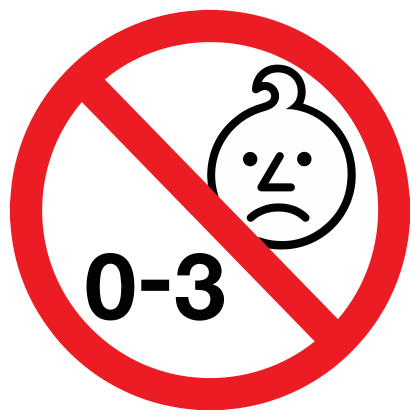
CAUTION! Not suitable for children under 3 years of age. It contains small parts which could be swallowed or inhaled.