







Language:
English

|
|
|
|
|
Albuera 1811 Beresford Vs. Soult
Publisher: Strategemata
 Do you want to sell your copy of this game?

Use our marketplace utrade!
Albuera 1811 Beresford Vs. Soult
Contact us
Share on
The item is not available, you can use the alert to be notified when it will be back in stock.
 Description
“Albuera 1811: Beresford vs. Soult” depicts the fiercest battle of the Peninsula War. Both engaged armies suffered terrible losses. Players can check if success could be achieved with lower cost. Rules concentrate on infantry maneuvers on Napoleonic battlefield. It is important to form battalion into proper array in the right time. Intuitively Line gives advantages during musketry fire and Column is powerful in hand-to-hand fighting. Important is also placing an infantry battalion regarding to neighboring units. Flank-to-flank deployment gives farther bonuses in ranged combat and forms solid order of the whole army. An infantry battalion can detach a company of skirmishers. It is useful for screening battalion's main body and harass enemy units with volleys. The best form of defense against cavalry is Square. In the box are rectangle counters. They represent line with broad front. This simply solution shows British 2-row line historical advantage over French 3-row - rectangle counters occurs more often in allied army. Cavalry aspect is not so detailed, so cavalry is simply deployed in line formation. Artillery can move or fire. Of course horse artillery can do both actions during one activation. The biggest advantage is a range of fire. Command and control is simply. Players have certain Activation Chits and select some of them. Activation Chits of both players are placed in one Activation Pool. Blindly drawn Chit indicates formation which can move and initiate close combat. Melee is very bloody – both sides suffer losses, but the risk must be taken, because won clashes give Victory Points. Non-activated units do not move, but they are allowed to fire. Thanks to that the whole board is used and crucial events can happen everywhere, not only in activated map sector. The most common effect of fire combat is Morale Check. If unsuccessful, unit can withdraw – decision is up to the opposing player, so both players are involved for the whole gameplay. Generally random factor is big, but players can feel reality of Napoleonic battlefield. The winner is player who properly deploys his units and uses opportunities given by Fate of War. Contents of the box: • one rulebook (16 pages); • one board (68 x 98 cm); • 648 die-cut counters (15 x 15 mm); • 25 die-cut counters (15 x 30 mm); • two scenario cards; • one 10-sided die. Game scale: One game turn – 15 minutes of real time One hex – 150 meters One strength point – 100 infantrymen or cavalrymen One artillery counter – from 1 to 8 guns.
 Additional information
| Mechanics: | |
| Categories: | |
| Alternative names: | |
| BARCODE: | ????????? |
| This was seen 628 times | |
Description
“Albuera 1811: Beresford vs. Soult” depicts the fiercest battle of the Peninsula War. Both engaged armies suffered terrible losses. Players can check if success could be achieved with lower cost. Rules concentrate on infantry maneuvers on Napoleonic battlefield. It is important to form battalion into proper array in the right time. Intuitively Line gives advantages during musketry fire and Column is powerful in hand-to-hand fighting. Important is also placing an infantry battalion regarding to neighboring units. Flank-to-flank deployment gives farther bonuses in ranged combat and forms solid order of the whole army. An infantry battalion can detach a company of skirmishers. It is useful for screening battalion's main body and harass enemy units with volleys. The best form of defense against cavalry is Square. In the box are rectangle counters. They represent line with broad front. This simply solution shows British 2-row line historical advantage over French 3-row - rectangle counters occurs more often in allied army. Cavalry aspect is not so detailed, so cavalry is simply deployed in line formation. Artillery can move or fire. Of course horse artillery can do both actions during one activation. The biggest advantage is a range of fire. Command and control is simply. Players have certain Activation Chits and select some of them. Activation Chits of both players are placed in one Activation Pool. Blindly drawn Chit indicates formation which can move and initiate close combat. Melee is very bloody – both sides suffer losses, but the risk must be taken, because won clashes give Victory Points. Non-activated units do not move, but they are allowed to fire. Thanks to that the whole board is used and crucial events can happen everywhere, not only in activated map sector. The most common effect of fire combat is Morale Check. If unsuccessful, unit can withdraw – decision is up to the opposing player, so both players are involved for the whole gameplay. Generally random factor is big, but players can feel reality of Napoleonic battlefield. The winner is player who properly deploys his units and uses opportunities given by Fate of War. Contents of the box: • one rulebook (16 pages); • one board (68 x 98 cm); • 648 die-cut counters (15 x 15 mm); • 25 die-cut counters (15 x 30 mm); • two scenario cards; • one 10-sided die. Game scale: One game turn – 15 minutes of real time One hex – 150 meters One strength point – 100 infantrymen or cavalrymen One artillery counter – from 1 to 8 guns.
Additional information
| Mechanics: | |
| Categories: | |
| Alternative names: | |
| BARCODE: | ????????? |
| This was seen 628 times | |
What players say
uplay user ratings: No uplay reviews yet. Be the first!
Your review
Comments are moderated before publication: no links, insults or unrelated content. Respectful negative opinions are welcome.
Sign in to review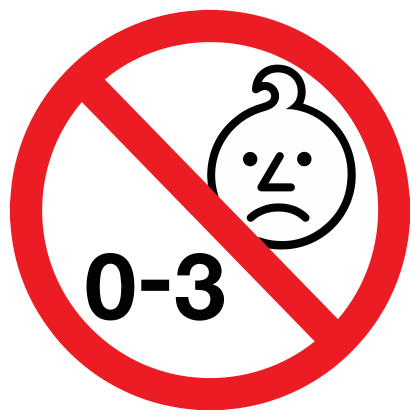
CAUTION! Not suitable for children under 3 years of age. It contains small parts which could be swallowed or inhaled.