









Language:
English
Portuguese



|
|
|
|
Best with 2 players
2 of 2 votes
Player-recommended age: 8+
1 of 1 votes
2
90'
8
Kein notwendiger Text im Spiel
|
Block
Publisher: Runadrake
 Do you want to sell your copy of this game?

Use our marketplace utrade!
Block
Contact us
Share on
The item is not available, you can use the alert to be notified when it will be back in stock.
PICTURES ON BGG
These photos are the property of boardgamegeek.com and do not refer specifically to the edition on this page.


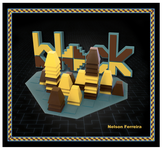


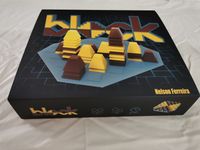
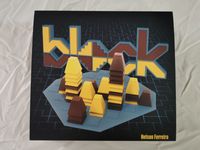
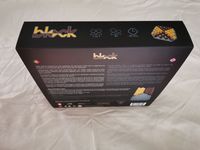
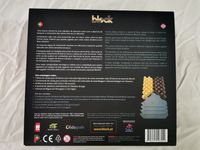
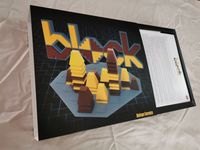
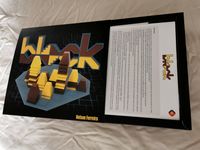
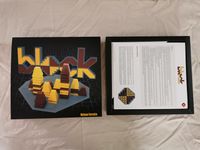
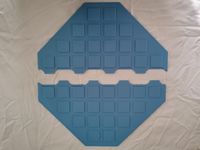
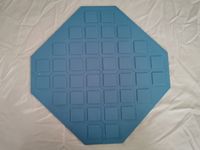
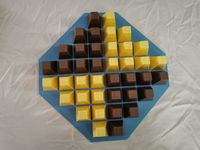
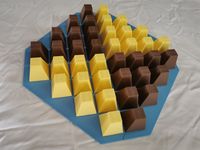
 Description
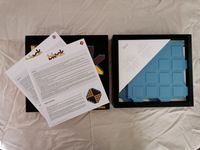
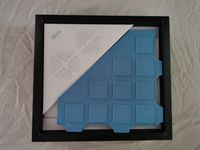
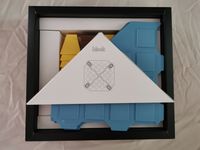
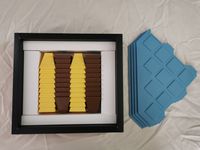
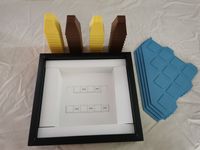
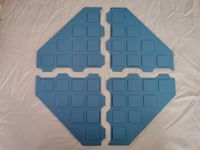
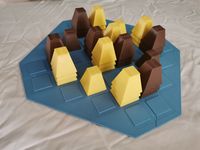
Block describes not the shape of the pieces in this abstract strategy game, but rather what you're trying to do to the opponent: Block her pieces from moving, and you win.
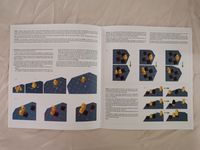
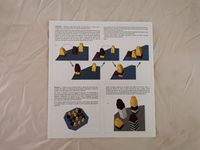
The board starts with forty pieces on it – twenty light and twenty dark, with the pieces grouped ten to a quadrant in alternating colors. On a turn, you move one stack that has your piece or pieces) on top. The stack moves as many spaces as the number of your pieces on top of the stack, and all movement is orthogonal to both the stack's starting location and each intermittent space to which it moves. Thus, a stack moving three spaces can first move to any orthogonally adjacent space, then move to any orthogonally adjacent space that's at a 90º angle to the first direction moved, then move a third time at a 90º angle to the second movement. Stacks cannot pass over other stacks while moving.
If a stack lands on a like-colored piece, that stack's movement will differ next time it moves; at most four pieces of the same color can be stacked together. If a stack lands on an empty space, the pieces on top must be split between that space and an adjacent space. A stack can land on a stack topped by the opposing color only if the stack moving has more pieces of the same color on top than the stack being moved onto; the stack that's topped is then trapped. If a player tops a stack that has trapped one or more of his pieces, he then frees the trapped pieces by moving the pieces on top to an adjacent space.
The first player who can't move on a turn loses the game.
The board starts with forty pieces on it – twenty light and twenty dark, with the pieces grouped ten to a quadrant in alternating colors. On a turn, you move one stack that has your piece or pieces) on top. The stack moves as many spaces as the number of your pieces on top of the stack, and all movement is orthogonal to both the stack's starting location and each intermittent space to which it moves. Thus, a stack moving three spaces can first move to any orthogonally adjacent space, then move to any orthogonally adjacent space that's at a 90º angle to the first direction moved, then move a third time at a 90º angle to the second movement. Stacks cannot pass over other stacks while moving.
If a stack lands on a like-colored piece, that stack's movement will differ next time it moves; at most four pieces of the same color can be stacked together. If a stack lands on an empty space, the pieces on top must be split between that space and an adjacent space. A stack can land on a stack topped by the opposing color only if the stack moving has more pieces of the same color on top than the stack being moved onto; the stack that's topped is then trapped. If a player tops a stack that has trapped one or more of his pieces, he then frees the trapped pieces by moving the pieces on top to an adjacent space.
The first player who can't move on a turn loses the game.
 Additional information
| Mechanics: | Action Point Allowance System |
| Categories: | Strategy |
| Alternative names: | |
| BARCODE: | ????????? |
| In 2 wishlists This was seen 6342 times | |
Description
Block describes not the shape of the pieces in this abstract strategy game, but rather what you're trying to do to the opponent: Block her pieces from moving, and you win.
The board starts with forty pieces on it – twenty light and twenty dark, with the pieces grouped ten to a quadrant in alternating colors. On a turn, you move one stack that has your piece or pieces) on top. The stack moves as many spaces as the number of your pieces on top of the stack, and all movement is orthogonal to both the stack's starting location and each intermittent space to which it moves. Thus, a stack moving three spaces can first move to any orthogonally adjacent space, then move to any orthogonally adjacent space that's at a 90º angle to the first direction moved, then move a third time at a 90º angle to the second movement. Stacks cannot pass over other stacks while moving.
If a stack lands on a like-colored piece, that stack's movement will differ next time it moves; at most four pieces of the same color can be stacked together. If a stack lands on an empty space, the pieces on top must be split between that space and an adjacent space. A stack can land on a stack topped by the opposing color only if the stack moving has more pieces of the same color on top than the stack being moved onto; the stack that's topped is then trapped. If a player tops a stack that has trapped one or more of his pieces, he then frees the trapped pieces by moving the pieces on top to an adjacent space.
The first player who can't move on a turn loses the game.
The board starts with forty pieces on it – twenty light and twenty dark, with the pieces grouped ten to a quadrant in alternating colors. On a turn, you move one stack that has your piece or pieces) on top. The stack moves as many spaces as the number of your pieces on top of the stack, and all movement is orthogonal to both the stack's starting location and each intermittent space to which it moves. Thus, a stack moving three spaces can first move to any orthogonally adjacent space, then move to any orthogonally adjacent space that's at a 90º angle to the first direction moved, then move a third time at a 90º angle to the second movement. Stacks cannot pass over other stacks while moving.
If a stack lands on a like-colored piece, that stack's movement will differ next time it moves; at most four pieces of the same color can be stacked together. If a stack lands on an empty space, the pieces on top must be split between that space and an adjacent space. A stack can land on a stack topped by the opposing color only if the stack moving has more pieces of the same color on top than the stack being moved onto; the stack that's topped is then trapped. If a player tops a stack that has trapped one or more of his pieces, he then frees the trapped pieces by moving the pieces on top to an adjacent space.
The first player who can't move on a turn loses the game.
Additional information
| Mechanics: | Action Point Allowance System |
| Categories: | Strategy |
| Alternative names: | |
| BARCODE: | ????????? |
| In 2 wishlists This was seen 6342 times | |
What players say
How many players it plays best with · 2 votes on BoardGameGeek
- 1 0 0 say it plays best, 0 recommend it, 0 do not recommend it
- 2 2 2 say it plays best, 0 recommend it, 0 do not recommend it
- 3 0 0 say it plays best, 0 recommend it, 0 do not recommend it
- 4 0 0 say it plays best, 0 recommend it, 0 do not recommend it
- 4+ 0 0 say it plays best, 0 recommend it, 0 do not recommend it
Best Suggested Not recommended
uplay user ratings: No uplay reviews yet. Be the first!
Your review
Comments are moderated before publication: no links, insults or unrelated content. Respectful negative opinions are welcome.
Sign in to review
CAUTION! Not suitable for children under 3 years of age. It contains small parts which could be swallowed or inhaled.