


Language:
English

|
|
|
|
Best with 2 players
1 of 1 votes
Player-recommended age: 14+
1 of 1 votes
1-2
120'
No necessary in-game text
|
Guderian's War: The German Advance on Moscow, 1941
Publisher: One Small Step
 Do you want to sell your copy of this game?

Use our marketplace utrade!
Guderian's War: The German Advance on Moscow, 1941
Contact us
Share on
The item is not available, you can use the alert to be notified when it will be back in stock.
PICTURES ON BGG
These photos are the property of boardgamegeek.com and do not refer specifically to the edition on this page.
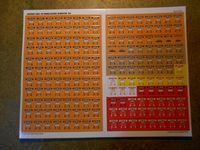
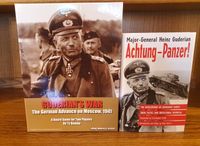
 Description
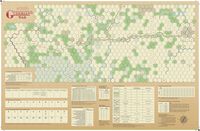
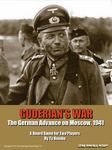
Guderian's War: The German Advance on Moscow, 1941 is a two-player, low-to-intermediate complexity, strategic simulation (with operational undertones) of the German drive on Moscow during Operation Barbarossa, a crucial part of their attempt to overrun the western Soviet Union in 1941. The German player is mainly on the offensive, attempting to win by seizing key areas on map faster than was done historically. The Soviet player is primarily on the defensive, but the situation also requires he prosecute almost continuous counteroffensives throughout the game.
Game play encompasses the period that began with the Germans launching their invasion on 22 June and ends on 1 September of the same year. The main thrust of the design is to test Guderian's oft-repeated claim he could've led Army Group Center into Moscow during that time, had he only been allowed by Hitler to run a true blitzkrieg.
The game may end sooner than the historic termination time, if the German player is able to do significantly better than his historic counterpart by advancing so quickly he causes the overall political, social, economic and military collapse of the Soviet Union. Alternatively, if the German player doesn't do well enough soon enough, he may lose the game in that it's then assumed Hitler loses faith in the idea of taking Moscow and instead turns AGC's panzers south to Kiev, just as occurred historically.
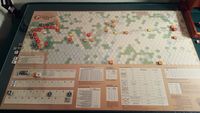
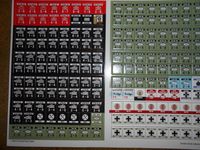
Each hexagon on the map represents 16 miles (26 km) from side to opposite side. The units of maneuver for both sides are primarily divisions, along with a few units of other sizes. Most German divisions have four steps, while most Soviet units are one-step with unknown strengths upon entry. The effects of the general air superiority enjoyed by the Germans throughout this campaign are built into the movement and combat rules. Each of the nine turns represents one week. The game is easily adaptable for solitaire play.
 Additional information
| Mechanics: | |
| Categories: | War |
| Alternative names: | |
| BARCODE: | ????????? |
| This was seen 1017 times | |
Description
Guderian's War: The German Advance on Moscow, 1941 is a two-player, low-to-intermediate complexity, strategic simulation (with operational undertones) of the German drive on Moscow during Operation Barbarossa, a crucial part of their attempt to overrun the western Soviet Union in 1941. The German player is mainly on the offensive, attempting to win by seizing key areas on map faster than was done historically. The Soviet player is primarily on the defensive, but the situation also requires he prosecute almost continuous counteroffensives throughout the game.
Game play encompasses the period that began with the Germans launching their invasion on 22 June and ends on 1 September of the same year. The main thrust of the design is to test Guderian's oft-repeated claim he could've led Army Group Center into Moscow during that time, had he only been allowed by Hitler to run a true blitzkrieg.
The game may end sooner than the historic termination time, if the German player is able to do significantly better than his historic counterpart by advancing so quickly he causes the overall political, social, economic and military collapse of the Soviet Union. Alternatively, if the German player doesn't do well enough soon enough, he may lose the game in that it's then assumed Hitler loses faith in the idea of taking Moscow and instead turns AGC's panzers south to Kiev, just as occurred historically.
Each hexagon on the map represents 16 miles (26 km) from side to opposite side. The units of maneuver for both sides are primarily divisions, along with a few units of other sizes. Most German divisions have four steps, while most Soviet units are one-step with unknown strengths upon entry. The effects of the general air superiority enjoyed by the Germans throughout this campaign are built into the movement and combat rules. Each of the nine turns represents one week. The game is easily adaptable for solitaire play.
Additional information
| Mechanics: | |
| Categories: | War |
| Alternative names: | |
| BARCODE: | ????????? |
| This was seen 1017 times | |
What players say
How many players it plays best with · 1 votes on BoardGameGeek
- 1 0 0 say it plays best, 1 recommend it, 0 do not recommend it
- 2 1 1 say it plays best, 0 recommend it, 0 do not recommend it
- 2+ 0 0 say it plays best, 0 recommend it, 1 do not recommend it
Best Suggested Not recommended
uplay user ratings: No uplay reviews yet. Be the first!
Your review
Comments are moderated before publication: no links, insults or unrelated content. Respectful negative opinions are welcome.
Sign in to review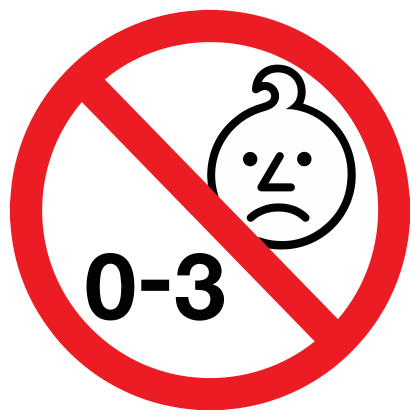
CAUTION! Not suitable for children under 3 years of age. It contains small parts which could be swallowed or inhaled.