








Language:
German

|
|
|
|
Best with 3 players
16 of 34 votes
Player-recommended age: 12+
5 of 7 votes
2-4
60'
10
No necessary in-game text
|
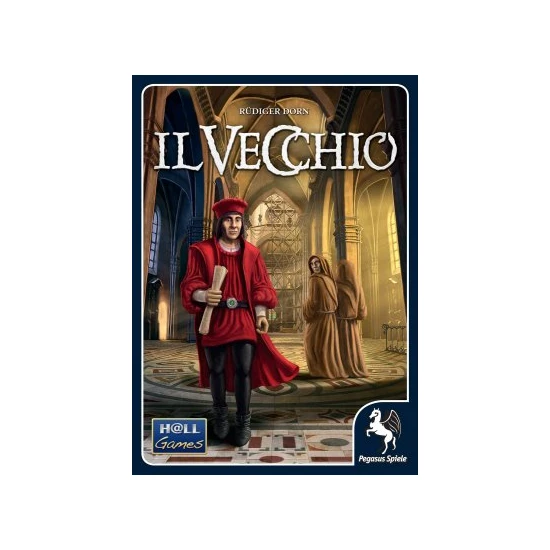
Il Vecchio
Publisher: H@LL Games
 Do you want to sell your copy of this game?

Use our marketplace utrade!
Il Vecchio
Contact us
Share on
The item is not available, you can use the alert to be notified when it will be back in stock.
PICTURES ON BGG
These photos are the property of boardgamegeek.com and do not refer specifically to the edition on this page.













 Description
Il Vecchio is set in the 15th century, when Cosimo de Medici – also called "Il Vecchio" ("the Elder) – and his family ruled over Tuscany and its capital Florence. The players represent the heads of Florentine families trying to rise their families to power. To achieve this, they send out their family members to locations in Tuscany to perform various tasks, specifically to recruit followers (knights, assassins, abbots) and collect money as both are needed to take control of provinces in neighboring regions; controlled provinces provide power and a bonus action. Another task is to gain the favor of the squirearchy as these favors are indispensable when it comes to getting an official position in Florence, e.g., a seat on the town council to enhance actions in Tuscany, or a noble rank to gain power at the end of the game.
To complete these tasks, however, a proper mediator must be present at a location, and as these mediators travel a lot, they are rarely met. That's why it is so important to have one's family members in the right place at the right time – to save on time and money while achieving one's goals.
At the beginning of the game, each player has four family members in Tuscany. Players take turns performing at least one action. Prior to his action(s), a player may pay money to move one of his own family members to another location. The available actions are to:
To complete these tasks, however, a proper mediator must be present at a location, and as these mediators travel a lot, they are rarely met. That's why it is so important to have one's family members in the right place at the right time – to save on time and money while achieving one's goals.
At the beginning of the game, each player has four family members in Tuscany. Players take turns performing at least one action. Prior to his action(s), a player may pay money to move one of his own family members to another location. The available actions are to:
- Take a location-specific action in Tuscany. This requires both a mediator and one of your own active (standing) family members at that location. After the action, this family member becomes inactive (i.e., is laid down).
- Travel to another region and take over a province, which costs both followers and money.
- Travel to Florence where you'll spend favors (and possibly money) to claim a town council tile and place it face-up before you or claim a nobles tile, placing it face down.
- Introduce a new family member to the board.
- Activate all inactive family members on the board.
 Additional information
| Mechanics: | Area Control/Area Influence Worker Placement |
| Categories: | Renaissance |
| Alternative names: | |
| BARCODE: | 4250231704215 |
| In 2 wishlists In 11 collections This was seen 5935 times | |
Description
Il Vecchio is set in the 15th century, when Cosimo de Medici – also called "Il Vecchio" ("the Elder) – and his family ruled over Tuscany and its capital Florence. The players represent the heads of Florentine families trying to rise their families to power. To achieve this, they send out their family members to locations in Tuscany to perform various tasks, specifically to recruit followers (knights, assassins, abbots) and collect money as both are needed to take control of provinces in neighboring regions; controlled provinces provide power and a bonus action. Another task is to gain the favor of the squirearchy as these favors are indispensable when it comes to getting an official position in Florence, e.g., a seat on the town council to enhance actions in Tuscany, or a noble rank to gain power at the end of the game.
To complete these tasks, however, a proper mediator must be present at a location, and as these mediators travel a lot, they are rarely met. That's why it is so important to have one's family members in the right place at the right time – to save on time and money while achieving one's goals.
At the beginning of the game, each player has four family members in Tuscany. Players take turns performing at least one action. Prior to his action(s), a player may pay money to move one of his own family members to another location. The available actions are to:
To complete these tasks, however, a proper mediator must be present at a location, and as these mediators travel a lot, they are rarely met. That's why it is so important to have one's family members in the right place at the right time – to save on time and money while achieving one's goals.
At the beginning of the game, each player has four family members in Tuscany. Players take turns performing at least one action. Prior to his action(s), a player may pay money to move one of his own family members to another location. The available actions are to:
- Take a location-specific action in Tuscany. This requires both a mediator and one of your own active (standing) family members at that location. After the action, this family member becomes inactive (i.e., is laid down).
- Travel to another region and take over a province, which costs both followers and money.
- Travel to Florence where you'll spend favors (and possibly money) to claim a town council tile and place it face-up before you or claim a nobles tile, placing it face down.
- Introduce a new family member to the board.
- Activate all inactive family members on the board.
Additional information
| Mechanics: | Area Control/Area Influence Worker Placement |
| Categories: | Renaissance |
| Alternative names: | |
| BARCODE: | 4250231704215 |
| In 2 wishlists In 11 collections This was seen 5935 times | |
 Frequently bought together


What players say · data and reviews published by users of BoardGameGeek
How many players it plays best with · 34 votes on BoardGameGeek
- 1 0 0 say it plays best, 1 recommend it, 10 do not recommend it
- 2 6 6 say it plays best, 21 recommend it, 2 do not recommend it
- 3 16 16 say it plays best, 7 recommend it, 0 do not recommend it
- 4 12 12 say it plays best, 15 recommend it, 0 do not recommend it
- 4+ 0 0 say it plays best, 0 recommend it, 10 do not recommend it
Best Suggested Not recommended

CAUTION! Not suitable for children under 3 years of age. It contains small parts which could be swallowed or inhaled.