











|
|
|
|
Best with 5 players
51 of 59 votes
Player-recommended age: 12+
4 of 9 votes
3-5
120'
10
Kilka słów, które łatwo zapamiętać
|
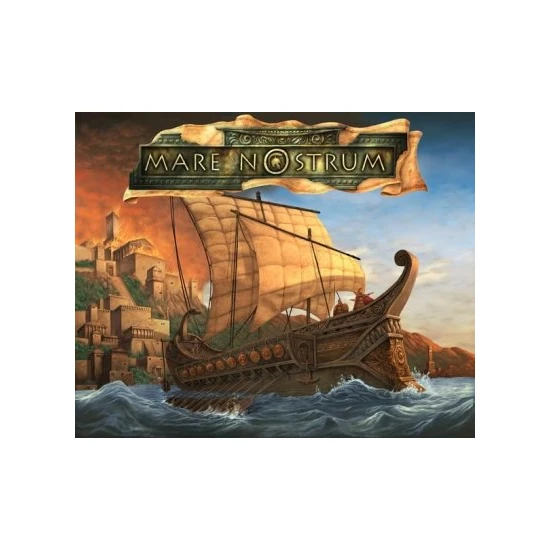
Mare Nostrum
Dive into ancient Mediterranean history with Mare Nostrum, a board game where trade and conquest intertwine. Manage your fleets, develop commerce and expand your empire with 3 to 5 players in about 120 minutes. A fascinating strategic experience for players ages 10 and up, published by Eurogames.
 Do you want to sell your copy of this game?










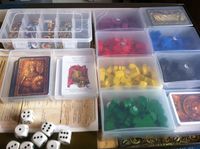








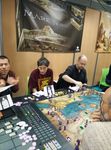
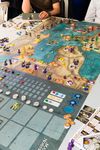
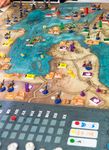


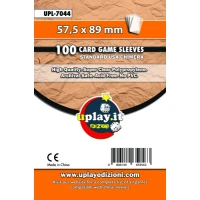
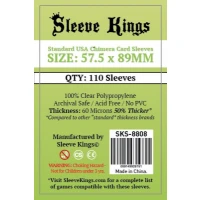
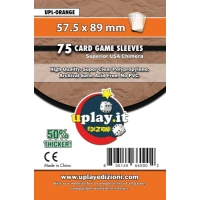
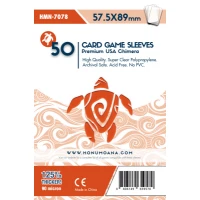
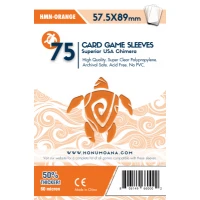
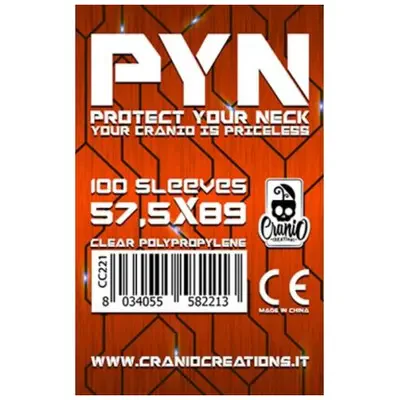
 Card sleeves in this game



 Description
Each power is characterized by a hero that will strongly influence its management: Julius Caesar allows the Romans to buy legions and fortresses at a lower price, Cleopatra allows the Egyptians to trade resources with taxes and vice versa, Pericles makes the Greeks the masters of the seas by making their triremes stronger and cheaper, Hannibal strengthens the Carthaginian legions, Hammurabi expands his Babylonian empire by one region for free.
The game develops in three different phases: the commercial phase, the political phase, and the military phase. For each phase, there is a Leader (indicated by three cards assigned at the beginning of the game to Carthaginians, Romans, and Egyptians) who regulates its course by deciding the order in which the various empires will act (trying to gain the most advantage, of course). The leader cards can, however, change ownership following the evolution of the empires and favoring respectively those with more cities/temples (political leader), military units (military leader), caravans/markets (trade director).
The goal of the game is to obtain the resources necessary to purchase three hero/wonder cards or to build the pyramids.
 Additional information
| Mechanics: | Area Control/Area Influence Dice Rolling Set Collection Trading Variable Player Powers |
| Categories: | Economic Civilization Historical |
| Alternative names: | Mare Nostrum Цивилизация Mare Nostrum Цивилизация |
| BARCODE: | ????????? |
| In 7 wishlists In 16 collections This was seen 15361 times | |
Description
Each power is characterized by a hero that will strongly influence its management: Julius Caesar allows the Romans to buy legions and fortresses at a lower price, Cleopatra allows the Egyptians to trade resources with taxes and vice versa, Pericles makes the Greeks the masters of the seas by making their triremes stronger and cheaper, Hannibal strengthens the Carthaginian legions, Hammurabi expands his Babylonian empire by one region for free.
The game develops in three different phases: the commercial phase, the political phase, and the military phase. For each phase, there is a Leader (indicated by three cards assigned at the beginning of the game to Carthaginians, Romans, and Egyptians) who regulates its course by deciding the order in which the various empires will act (trying to gain the most advantage, of course). The leader cards can, however, change ownership following the evolution of the empires and favoring respectively those with more cities/temples (political leader), military units (military leader), caravans/markets (trade director).
The goal of the game is to obtain the resources necessary to purchase three hero/wonder cards or to build the pyramids.
Card sleeves in this game
Additional information
| Mechanics: | Area Control/Area Influence Dice Rolling Set Collection Trading Variable Player Powers |
| Categories: | Economic Civilization Historical |
| Alternative names: | Mare Nostrum Цивилизация Mare Nostrum Цивилизация |
| BARCODE: | ????????? |
| In 7 wishlists In 16 collections This was seen 15361 times | |
What players say
How many players it plays best with · 59 votes on BoardGameGeek
- 1 0 0 say it plays best, 0 recommend it, 39 do not recommend it
- 2 0 0 say it plays best, 1 recommend it, 40 do not recommend it
- 3 2 2 say it plays best, 7 recommend it, 40 do not recommend it
- 4 3 3 say it plays best, 34 recommend it, 16 do not recommend it
- 5 51 51 say it plays best, 5 recommend it, 2 do not recommend it
- 5+ 4 4 say it plays best, 1 recommend it, 20 do not recommend it
Best Suggested Not recommended
uplay user ratings: No uplay reviews yet. Be the first!
Your review
Comments are moderated before publication: no links, insults or unrelated content. Respectful negative opinions are welcome.
Sign in to review
CAUTION! Not suitable for children under 3 years of age. It contains small parts which could be swallowed or inhaled.