









Language:
English
Italian
German
French
Spanish





+1
Dutch


|
|
|
|
Best with 2 players
21 of 22 votes
Player-recommended age: 8+
6 of 12 votes
2
20'
7
No necessary in-game text
|
Okiya
Publisher: Jactalea

 Do you want to sell your copy of this game?

Use our marketplace utrade!
Okiya
Contact us
Share on
The item is not available, you can use the alert to be notified when it will be back in stock.
PICTURES ON BGG
These photos are the property of boardgamegeek.com and do not refer specifically to the edition on this page.









 Description
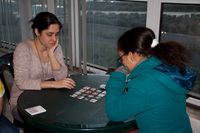
In Okiya, subtitled "The House of the Geishas", each player tries to arrange her geisha tiles in a pleasing manner in order to gain the favor of the emperor. Alternatively, you can prevent your rival from placing a geisha in the Imperial garden, showing that you have more control than your opponent.
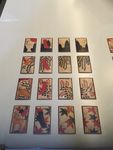
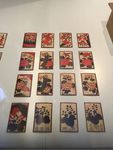
To set up the game, shuffle the 16 tiles and arrange them in a 4x4 square; each tile shows one of four types of vegetation (maple, cherry, pine or iris) and one of four types of poetic symbols (rising sun, bird, rain or tanzaku - the small pieces of paper on which people sometimes write wishes).
The starting player removes one tile on the border of the square, sets this tile aside, then places one of her geisha tokens in this space. The opponent must then do the same thing, but can choose from only those tiles that depict the same type of vegetation or poetic symbol shown on the tile first set aside. Play continues, with each set-aside tile determining where the next player can go until:
A player forms a line with four of her geisha tokens in any direction,
A player forms a 2x2 square with four of her geisha tokens, or
A player chooses a tile which doesn't allow her opponent to place a geisha token.
In any of these cases, the player has won the game. A match can be a single game, a "best of three" series, or a point-based match, with the winner of a game earning as many points as the number of tiles remaining in the grid when she wins; in this case, the player who first collects ten points wins the match.
 Additional information
| Mechanics: | Pattern Recognition |
| Categories: | Strategy |
| Alternative names: | Geisha Kizz-Kizz La Bataille des Sorciers Niya Okiya Окія Окийя 御木屋 |
| BARCODE: | ??????????? |
| In 1 wishlist In 3 collections This was seen 5256 times | |
Description
In Okiya, subtitled "The House of the Geishas", each player tries to arrange her geisha tiles in a pleasing manner in order to gain the favor of the emperor. Alternatively, you can prevent your rival from placing a geisha in the Imperial garden, showing that you have more control than your opponent.
To set up the game, shuffle the 16 tiles and arrange them in a 4x4 square; each tile shows one of four types of vegetation (maple, cherry, pine or iris) and one of four types of poetic symbols (rising sun, bird, rain or tanzaku - the small pieces of paper on which people sometimes write wishes).
The starting player removes one tile on the border of the square, sets this tile aside, then places one of her geisha tokens in this space. The opponent must then do the same thing, but can choose from only those tiles that depict the same type of vegetation or poetic symbol shown on the tile first set aside. Play continues, with each set-aside tile determining where the next player can go until:
A player forms a line with four of her geisha tokens in any direction,
A player forms a 2x2 square with four of her geisha tokens, or
A player chooses a tile which doesn't allow her opponent to place a geisha token.
In any of these cases, the player has won the game. A match can be a single game, a "best of three" series, or a point-based match, with the winner of a game earning as many points as the number of tiles remaining in the grid when she wins; in this case, the player who first collects ten points wins the match.
To set up the game, shuffle the 16 tiles and arrange them in a 4x4 square; each tile shows one of four types of vegetation (maple, cherry, pine or iris) and one of four types of poetic symbols (rising sun, bird, rain or tanzaku - the small pieces of paper on which people sometimes write wishes).
The starting player removes one tile on the border of the square, sets this tile aside, then places one of her geisha tokens in this space. The opponent must then do the same thing, but can choose from only those tiles that depict the same type of vegetation or poetic symbol shown on the tile first set aside. Play continues, with each set-aside tile determining where the next player can go until:
A player forms a line with four of her geisha tokens in any direction,
A player forms a 2x2 square with four of her geisha tokens, or
A player chooses a tile which doesn't allow her opponent to place a geisha token.
In any of these cases, the player has won the game. A match can be a single game, a "best of three" series, or a point-based match, with the winner of a game earning as many points as the number of tiles remaining in the grid when she wins; in this case, the player who first collects ten points wins the match.
Additional information
| Mechanics: | Pattern Recognition |
| Categories: | Strategy |
| Alternative names: | Geisha Kizz-Kizz La Bataille des Sorciers Niya Okiya Окія Окийя 御木屋 |
| BARCODE: | ??????????? |
| In 1 wishlist In 3 collections This was seen 5256 times | |
 Frequently bought together


What players say
How many players it plays best with · 22 votes on BoardGameGeek
- 1 0 0 say it plays best, 0 recommend it, 18 do not recommend it
- 2 21 21 say it plays best, 1 recommend it, 0 do not recommend it
- 2+ 0 0 say it plays best, 1 recommend it, 17 do not recommend it
Best Suggested Not recommended
uplay user ratings: No uplay reviews yet. Be the first!
Your review
Comments are moderated before publication: no links, insults or unrelated content. Respectful negative opinions are welcome.
Sign in to review
CAUTION! Not suitable for children under 3 years of age. It contains small parts which could be swallowed or inhaled.