
-
Choose website language
-
 Deutsch
DE
Deutsch
DE
-
 English
EN
English
EN
-
 Français
FR
Français
FR
-
 Español
ES
Español
ES
-
 Italiano
IT
Italiano
IT
-
 Polski
PL
Polski
PL
-
 Português
PT
Português
PT
-
Country to ship to






-
Choose website language
-
Deutsch
DE
-
English
EN
-
Français
FR
-
Español
ES
-
Italiano
IT
-
Polski
PL
-
Português
PT
-
Country to ship to

 (+39) 320 073 4588
 CONTACT US VIA EMAIL
-
Choose website language
-
Deutsch
DE
-
English
EN
-
Français
FR
-
Español
ES
-
Italiano
IT
-
Polski
PL
-
Português
PT
-
Country to ship to

-
Menu
-
Ranks

-
Boardgame

-
RPG

-
Party

-
CG

-
Accessories
-
Lego
-
Books

-
Comics

|
|
|
|
|
Border Riding Deluxe Edition
 Do you want to sell your copy of this game?

 Available in an external warehouse.
Shipping in about 3/7 days
Sale Price
 Description
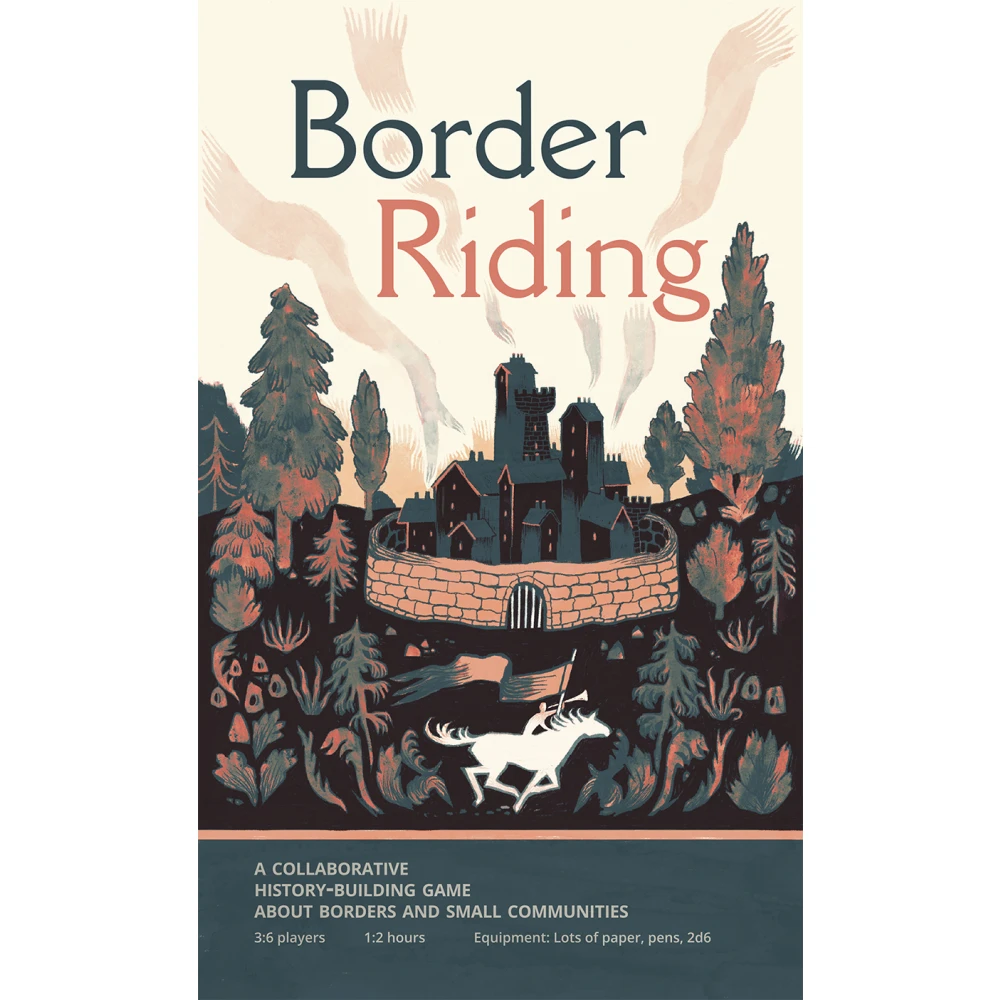
This is a game about boundaries, how we mark them and who we include or exclude from them. While inspired by the Common Ridings festivals in the Scottish Borders, this game can be about any community, and take place at any time, in any setting.
Border Riding explores how arbitrary borders can create real long-lasting divisions between communities, and how petty village rivalries can turn into full blown conflicts. By following these communities and their border rituals over time, you will also explore how, in seeking safety from perceived threats, communities can vilify and warmly welcome those that fall outside of a drawn border.
At a glance:
- Collaborative map drawing game.
- 3 to 6 players (solo and duo modes also included.)
- Played over rounds, with each player taking turns to lead each round.
- Invent a community, and watch it face challenges over the passing years.
- Create a series of maps that stack atop one another. Hold them up to a window at the end of play to see redrawn lines shine through onto the present.
- Requires 2D6, pens, 10 to 20 sheets of paper, 1 to 2 hours to play.
Its touchstones include Avery Alder’s The Quiet Year, Everest Pipkin’s zine-game The Ground Itself and Iman Tajik’s project Bordered Miles.
This is a GM-less map drawing game. You'll collaboratively draw maps on blank pieces of paper for a community that you will invent with your friends, recording its landmarks, its boundary, who the community thinks of as "Us", and which neighbours the community thinks of as "Them".
You'll need 3 or more players, pens, a d6, and a lot of paper. Each game takes 1 to 2 hours to complete. You can play on any Virtual Tabletop that allows you to draw (like Roll20). You can trace the large map to quick-start your game, or invent your own maps from scratch.
Players take it in turn to lead each round, introducing events for the community to resolve. A new map is drawn with each round, laid over a growing stack of maps as the game progress. Years pass with each round, and your community will face challenges across multiple evolving storylines.
At the end of the game, your community will have grown over generations. Hold your maps up to a window, and see the faded lines of villages past shine through to your town into the present. At the game's end, you'll jump 500 years into the future, and compare how your community might have changed, and examine if any of the original challenges (and their resolutions) ever mattered.
This game is a love letter to Common Riding festivals. They take place every summer in the Scottish Borders, and are a tradition founded in war, where communities had to reassert their borders from land-stealing lords and encroaching armies. They've evolved over centuries into small town pageantry, central to each village's unique identity.
When creating a game about boundaries, it is important to recognise the real life violence and discrimination they create. We consulted with Romani TTRPG creator Penny Blake when writing this game, with the aim of not reproducing harmful tropes.
Among its many themes, Border Riding is intended to explore how arbitrary borders can create real long-lasting divisions between communities, and how petty village rivalries can turn into full blown conflicts. The game includes advice on how to handle topics like xenophobia at your table, and directs towards existing safety tools which may make your game more comfortable for all players involved.
 Additional information
| Mechanics: | |
| Categories: | |
| Alternative names: | |
| BARCODE: | 9781915555083 |
| This was seen 92 times | |
Description
This is a game about boundaries, how we mark them and who we include or exclude from them. While inspired by the Common Ridings festivals in the Scottish Borders, this game can be about any community, and take place at any time, in any setting.
Border Riding explores how arbitrary borders can create real long-lasting divisions between communities, and how petty village rivalries can turn into full blown conflicts. By following these communities and their border rituals over time, you will also explore how, in seeking safety from perceived threats, communities can vilify and warmly welcome those that fall outside of a drawn border.
At a glance:
- Collaborative map drawing game.
- 3 to 6 players (solo and duo modes also included.)
- Played over rounds, with each player taking turns to lead each round.
- Invent a community, and watch it face challenges over the passing years.
- Create a series of maps that stack atop one another. Hold them up to a window at the end of play to see redrawn lines shine through onto the present.
- Requires 2D6, pens, 10 to 20 sheets of paper, 1 to 2 hours to play.
Its touchstones include Avery Alder’s The Quiet Year, Everest Pipkin’s zine-game The Ground Itself and Iman Tajik’s project Bordered Miles.
This is a GM-less map drawing game. You'll collaboratively draw maps on blank pieces of paper for a community that you will invent with your friends, recording its landmarks, its boundary, who the community thinks of as "Us", and which neighbours the community thinks of as "Them".
You'll need 3 or more players, pens, a d6, and a lot of paper. Each game takes 1 to 2 hours to complete. You can play on any Virtual Tabletop that allows you to draw (like Roll20). You can trace the large map to quick-start your game, or invent your own maps from scratch.
Players take it in turn to lead each round, introducing events for the community to resolve. A new map is drawn with each round, laid over a growing stack of maps as the game progress. Years pass with each round, and your community will face challenges across multiple evolving storylines.
At the end of the game, your community will have grown over generations. Hold your maps up to a window, and see the faded lines of villages past shine through to your town into the present. At the game's end, you'll jump 500 years into the future, and compare how your community might have changed, and examine if any of the original challenges (and their resolutions) ever mattered.
This game is a love letter to Common Riding festivals. They take place every summer in the Scottish Borders, and are a tradition founded in war, where communities had to reassert their borders from land-stealing lords and encroaching armies. They've evolved over centuries into small town pageantry, central to each village's unique identity.
When creating a game about boundaries, it is important to recognise the real life violence and discrimination they create. We consulted with Romani TTRPG creator Penny Blake when writing this game, with the aim of not reproducing harmful tropes.
Among its many themes, Border Riding is intended to explore how arbitrary borders can create real long-lasting divisions between communities, and how petty village rivalries can turn into full blown conflicts. The game includes advice on how to handle topics like xenophobia at your table, and directs towards existing safety tools which may make your game more comfortable for all players involved.
Additional information
| Mechanics: | |
| Categories: | |
| Alternative names: | |
| BARCODE: | 9781915555083 |
| This was seen 92 times | |
CAUTION! Not suitable for children under 3 years of age. It contains small parts which could be swallowed or inhaled.