









 (+39) 320 073 4588
 CONTACT US VIA EMAIL

-
Menu

-
Ranks

-
Boardgame

-
RPG

-
Party

-
CG

-
Accessories

-
Lego



|
|
|





2
15'
8
No necessary in-game text
|
Kamon
 Do you want to sell your copy of this game?








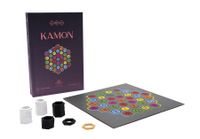




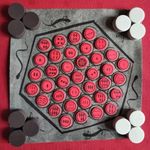
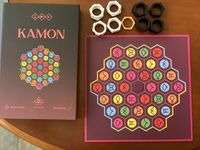
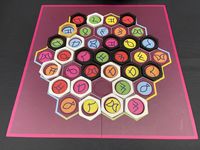


 Description
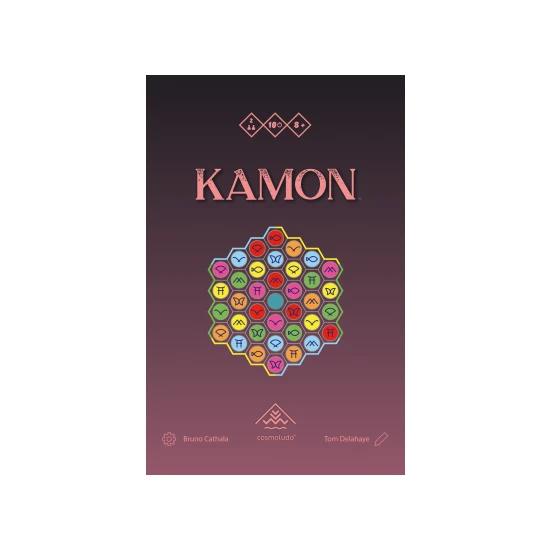
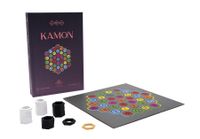
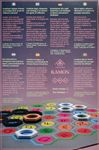
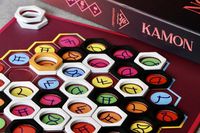
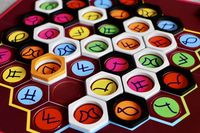
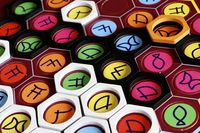
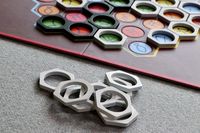
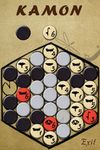
In the two-player abstract strategy game, Kamon, a hexagonal board is filled randomly with 36 tokens. Each token is valued 1-6, in each of 6 different symbols. The black player starts by replacing one of the tokens with one of their 18 pawns. The white player does the same thing, now constrained by black's choice: The token she selects must be either the same symbol or the same number. The game ends immediately when one of three victory conditions are fulfilled: A player connects two opposite edges with their pawns (as in Hex). A player completely surrounds one or more spaces - those spaces could be either empty or occupied by the opponent's pawns. A player has prevented their opponent from playing any more. Reimplemented by Okiya
 Additional information
| Mechanics: | Area Enclosure |
| Categories: | Strategy |
| Alternative names: | |
| This was seen 1211 times | |
Description
In the two-player abstract strategy game, Kamon, a hexagonal board is filled randomly with 36 tokens. Each token is valued 1-6, in each of 6 different symbols. The black player starts by replacing one of the tokens with one of their 18 pawns. The white player does the same thing, now constrained by black's choice: The token she selects must be either the same symbol or the same number. The game ends immediately when one of three victory conditions are fulfilled: A player connects two opposite edges with their pawns (as in Hex). A player completely surrounds one or more spaces - those spaces could be either empty or occupied by the opponent's pawns. A player has prevented their opponent from playing any more. Reimplemented by Okiya
Additional information
| Mechanics: | Area Enclosure |
| Categories: | Strategy |
| Alternative names: | |
| This was seen 1211 times | |
CAUTION! Not suitable for children under 3 years of age. It contains small parts which could be swallowed or inhaled.