









Language:
English
Italian
rules online


|
|
|
|
Best with 3 players
5 of 12 votes
Player-recommended age: 8+
3 of 5 votes
2-4
45'
8
No necessary in-game text
|
Kairo
Publisher: Queen Games
 Do you want to sell your copy of this game?

Use our marketplace utrade!
Kairo
Contact us
Share on
The item is not available, you can use the alert to be notified when it will be back in stock.
PICTURES ON BGG
These photos are the property of boardgamegeek.com and do not refer specifically to the edition on this page.







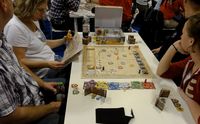


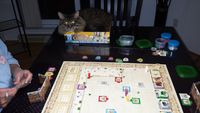
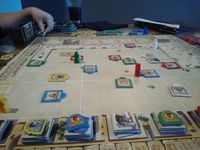
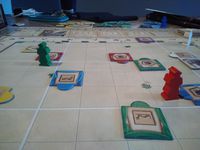
 Card sleeves in this game
40 cards of 52.0mm width and 52.0mm of height
1x
(110 Pcs)

1x
(55 Pcs)

1x
(100 Pcs)

1x
(50 Pcs)

1x
(100 Pcs)

1x
(50 Pcs)

 Description
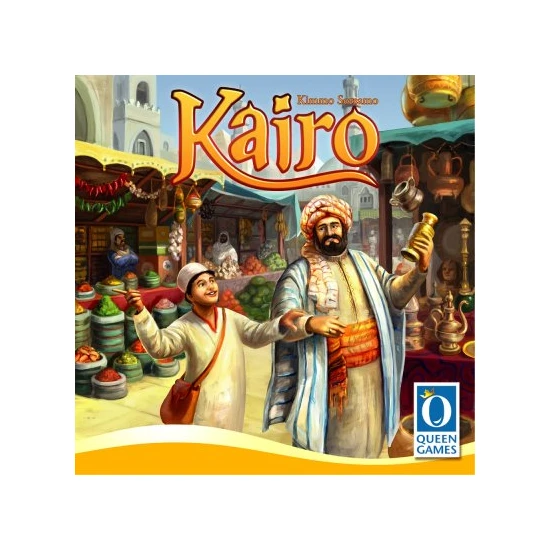
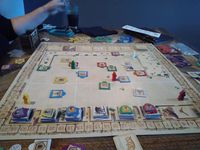
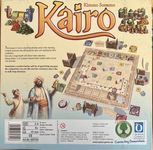
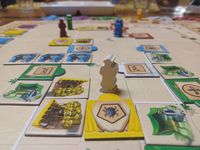
In the bustling market of Cairo, traders build their stalls and try to entice customers with attractive goods, with each customer bringing money that the trader can then use to expand that stall or establish new stalls.
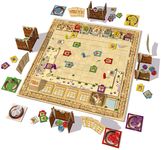
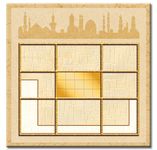
To set up Kairo, players first take turns placing three colored stalls (out of six) on the game board. They also take three stall cards (which highlight one or more sections on the game board) and one coin of each of the six colors. Five colored customers start at particular locations on the game board, with the sixth customer placed to the side. On a turn, a player either:
When building a new stall, a player cannot place it in the same region as another stall of the same color. Regulations! Restaurants must be placed in an area designated for them, while all other stalls must go in the market area. When expanding an existing stall, the player must pay one coin of the same color for each tile in the enlarged stall. By expanding, you can earn more coins when customers visit, create longer paths to opponents' stalls, reserve area in which to expand further, and (most importantly) earn victory points. You score VPs each time you expand, and if your stall is the largest (or tied for the largest) of that color, you'll take one or two medals that provide a VP bonus.
Once the expansions run low in one or two colors, players can only build or expand. Once everyone has finished building, the game ends, with players earning VPs for the medals and money they have in hand. The player with the most points wins.
To set up Kairo, players first take turns placing three colored stalls (out of six) on the game board. They also take three stall cards (which highlight one or more sections on the game board) and one coin of each of the six colors. Five colored customers start at particular locations on the game board, with the sixth customer placed to the side. On a turn, a player either:
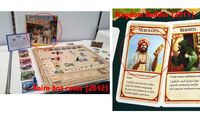
- Draws two cards (face-up or face-down stall cards or market barker cards).
- Moves a customer to a stall of that customer's color.
- Plays a stall card, then builds a new stall, expands an existing stall or moves a blocked-off stall.
When building a new stall, a player cannot place it in the same region as another stall of the same color. Regulations! Restaurants must be placed in an area designated for them, while all other stalls must go in the market area. When expanding an existing stall, the player must pay one coin of the same color for each tile in the enlarged stall. By expanding, you can earn more coins when customers visit, create longer paths to opponents' stalls, reserve area in which to expand further, and (most importantly) earn victory points. You score VPs each time you expand, and if your stall is the largest (or tied for the largest) of that color, you'll take one or two medals that provide a VP bonus.
Once the expansions run low in one or two colors, players can only build or expand. Once everyone has finished building, the game ends, with players earning VPs for the medals and money they have in hand. The player with the most points wins.
 Additional information
| Mechanics: | Hand Management Tile Placement |
| Categories: | Strategy |
| Alternative names: | |
| BARCODE: | 4010350607428 |
| In 1 wishlist In 1 collection This was seen 9545 times | |
Description
In the bustling market of Cairo, traders build their stalls and try to entice customers with attractive goods, with each customer bringing money that the trader can then use to expand that stall or establish new stalls.
To set up Kairo, players first take turns placing three colored stalls (out of six) on the game board. They also take three stall cards (which highlight one or more sections on the game board) and one coin of each of the six colors. Five colored customers start at particular locations on the game board, with the sixth customer placed to the side. On a turn, a player either:
When building a new stall, a player cannot place it in the same region as another stall of the same color. Regulations! Restaurants must be placed in an area designated for them, while all other stalls must go in the market area. When expanding an existing stall, the player must pay one coin of the same color for each tile in the enlarged stall. By expanding, you can earn more coins when customers visit, create longer paths to opponents' stalls, reserve area in which to expand further, and (most importantly) earn victory points. You score VPs each time you expand, and if your stall is the largest (or tied for the largest) of that color, you'll take one or two medals that provide a VP bonus.
Once the expansions run low in one or two colors, players can only build or expand. Once everyone has finished building, the game ends, with players earning VPs for the medals and money they have in hand. The player with the most points wins.
To set up Kairo, players first take turns placing three colored stalls (out of six) on the game board. They also take three stall cards (which highlight one or more sections on the game board) and one coin of each of the six colors. Five colored customers start at particular locations on the game board, with the sixth customer placed to the side. On a turn, a player either:
- Draws two cards (face-up or face-down stall cards or market barker cards).
- Moves a customer to a stall of that customer's color.
- Plays a stall card, then builds a new stall, expands an existing stall or moves a blocked-off stall.
When building a new stall, a player cannot place it in the same region as another stall of the same color. Regulations! Restaurants must be placed in an area designated for them, while all other stalls must go in the market area. When expanding an existing stall, the player must pay one coin of the same color for each tile in the enlarged stall. By expanding, you can earn more coins when customers visit, create longer paths to opponents' stalls, reserve area in which to expand further, and (most importantly) earn victory points. You score VPs each time you expand, and if your stall is the largest (or tied for the largest) of that color, you'll take one or two medals that provide a VP bonus.
Once the expansions run low in one or two colors, players can only build or expand. Once everyone has finished building, the game ends, with players earning VPs for the medals and money they have in hand. The player with the most points wins.
Card sleeves in this game
40 cards of 52.0mm width and 52.0mm of height
1x
(110 Pcs)
1x
(55 Pcs)
1x
(100 Pcs)
1x
(50 Pcs)
1x
(100 Pcs)
1x
(50 Pcs)
Additional information
| Mechanics: | Hand Management Tile Placement |
| Categories: | Strategy |
| Alternative names: | |
| BARCODE: | 4010350607428 |
| In 1 wishlist In 1 collection This was seen 9545 times | |
 Frequently bought together
What players say
How many players it plays best with · 12 votes on BoardGameGeek
- 1 0 0 say it plays best, 1 recommend it, 5 do not recommend it
- 2 1 1 say it plays best, 4 recommend it, 1 do not recommend it
- 3 5 5 say it plays best, 4 recommend it, 0 do not recommend it
- 4 2 2 say it plays best, 4 recommend it, 1 do not recommend it
- 4+ 0 0 say it plays best, 0 recommend it, 5 do not recommend it
Best Suggested Not recommended
uplay user ratings: No uplay reviews yet. Be the first!
Your review
Comments are moderated before publication: no links, insults or unrelated content. Respectful negative opinions are welcome.
Sign in to review
CAUTION! Not suitable for children under 3 years of age. It contains small parts which could be swallowed or inhaled.