



Language:
English
|
|
|
|
1-2
No necessary in-game text
|
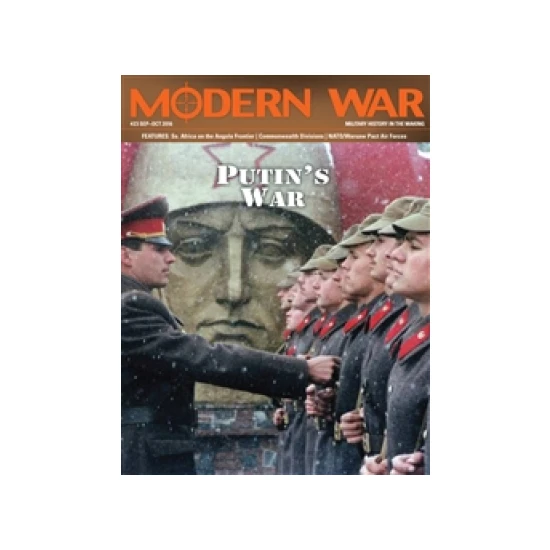
Putin's War
Publisher: Decision Games (I)
 Do you want to sell your copy of this game?

Use our marketplace utrade!
Putin's War
Contact us
Share on
The item is not available, you can use the alert to be notified when it will be back in stock.
PICTURES ON BGG
These photos are the property of boardgamegeek.com and do not refer specifically to the edition on this page.
 Description
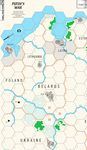
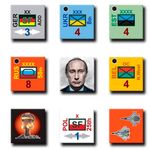
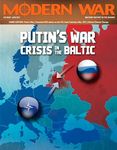
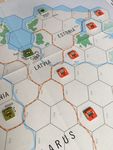
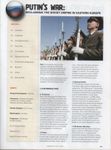
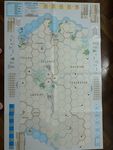
The main idea is, NATO devolves toward operational ineffectiveness and, on that basis, old Vladimir decides to try for the big solution to get back all the former Soviet Union's western borderlands.
In designing the game (already done despite the long wait for its publication), I came up with a new system that emphasizes the following perspective: today's First World militaries are part way through a systemic transformation broadly comparable to the one they went through during the 1930s.
The issue in the 30s was how to integrate mechanization into what otherwise still remained foot-slogging, horse-drawn armies. The debate centered around how much horse cavalry to keep mixed in with the tanks, trucks and other combat vehicles. The idea was the large mass of unmotorized units would form a "base of maneuver" from which the relatively more scarce -- but elite -- moto-mech units would operate.
Of course, by the war's midpoint all that had been settled. The question had come to center on determining the optimal mix of tracked and wheeled vehicles, etc.
Today, we're witnessing a similar transformation in that the former moto-mech elite has, in effect, taken on the role of the previous era's foot-sloggers and horse cavalry: they're now the new "base of maneuver" element, holding the line while, evolving atop and past them, is the new elite: the special forces, which are themselves increasingly robot-equipped.
Given that the cost and social advantages involved in deploying small elites rather than the mass mechanized armies of the previous era (the draft isn't going to come back), I see us now at about the 1938-equivalent in terms of the new transition.
Aside from that, another characteristic is more and more of the First World's armies combat experience is increasingly contained within the personnel of the SoF. That, of course, further enhances their relative combat power.
To smoothly model all that, I've come up a system I've titled the "Big And Dumb Armies Super System" (BADASS). I'll be using it again.
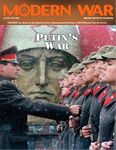
This design will be appearing in Modern War issue number 29 (May-June 2017).
 Additional information
| Mechanics: | |
| Categories: | War |
| Alternative names: | Putin's War: Crisis in the Baltic Putin's War: Reclaiming the Soviet Empire in Eastern Europe |
| BARCODE: | 7148602334005 |
| This was seen 1427 times | |
Description
The main idea is, NATO devolves toward operational ineffectiveness and, on that basis, old Vladimir decides to try for the big solution to get back all the former Soviet Union's western borderlands.
In designing the game (already done despite the long wait for its publication), I came up with a new system that emphasizes the following perspective: today's First World militaries are part way through a systemic transformation broadly comparable to the one they went through during the 1930s.
The issue in the 30s was how to integrate mechanization into what otherwise still remained foot-slogging, horse-drawn armies. The debate centered around how much horse cavalry to keep mixed in with the tanks, trucks and other combat vehicles. The idea was the large mass of unmotorized units would form a "base of maneuver" from which the relatively more scarce -- but elite -- moto-mech units would operate.
Of course, by the war's midpoint all that had been settled. The question had come to center on determining the optimal mix of tracked and wheeled vehicles, etc.
Today, we're witnessing a similar transformation in that the former moto-mech elite has, in effect, taken on the role of the previous era's foot-sloggers and horse cavalry: they're now the new "base of maneuver" element, holding the line while, evolving atop and past them, is the new elite: the special forces, which are themselves increasingly robot-equipped.
Given that the cost and social advantages involved in deploying small elites rather than the mass mechanized armies of the previous era (the draft isn't going to come back), I see us now at about the 1938-equivalent in terms of the new transition.
Aside from that, another characteristic is more and more of the First World's armies combat experience is increasingly contained within the personnel of the SoF. That, of course, further enhances their relative combat power.
To smoothly model all that, I've come up a system I've titled the "Big And Dumb Armies Super System" (BADASS). I'll be using it again.
This design will be appearing in Modern War issue number 29 (May-June 2017).
Additional information
| Mechanics: | |
| Categories: | War |
| Alternative names: | Putin's War: Crisis in the Baltic Putin's War: Reclaiming the Soviet Empire in Eastern Europe |
| BARCODE: | 7148602334005 |
| This was seen 1427 times | |
What players say
How many players it plays best with · 0 votes on BoardGameGeek
- 1 0 0 say it plays best, 0 recommend it, 0 do not recommend it
- 2 0 0 say it plays best, 0 recommend it, 0 do not recommend it
- 2+ 0 0 say it plays best, 0 recommend it, 0 do not recommend it
Best Suggested Not recommended
uplay user ratings: No uplay reviews yet. Be the first!
Your review
Comments are moderated before publication: no links, insults or unrelated content. Respectful negative opinions are welcome.
Sign in to review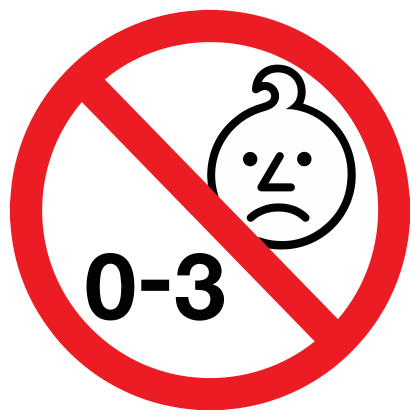
CAUTION! Not suitable for children under 3 years of age. It contains small parts which could be swallowed or inhaled.