







Language:
English


|
|
|
|
Best with 2 players
1 of 1 votes
Player-recommended age: 6+
1 of 1 votes
2-4
35'
8
No necessary in-game text
|
Search for Gnomes
Publisher: Simployt Games
 Do you want to sell your copy of this game?

Use our marketplace utrade!
Search for Gnomes
Contact us
Share on
The item is not available, you can use the alert to be notified when it will be back in stock.
PICTURES ON BGG
These photos are the property of boardgamegeek.com and do not refer specifically to the edition on this page.
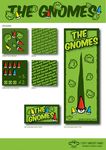




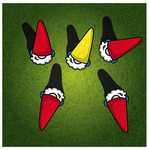
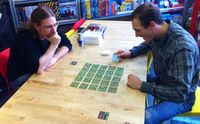

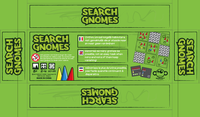



 Description
Players attempt to remember as many gnomes as possible in about 15 seconds time.
Each round every player tries to find the right amount of gnomes for each mission played.
After 6 rounds (2 player game) or 4 rounds (4 player game) the player with the most points wins.
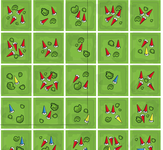
The start player shuffles the 20 mission tiles placing them face down on the table. The start player then shuffles the 25 forest tiles to place them face up in a 5 x 5 grid visible for everyone on the table.
The game starts, everyone tries to remember as many gnomes and colors on the 5 x 5 grid on the table. After 15 seconds (you need a watch) everyone together turns the 25 tiles face down.
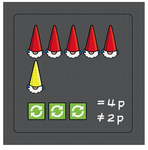
The start player takes 1 mission tile (for everyone to see) and tries to complete the requested mission tile.
The next player turns a mission and does the same...
The bidding round starts when every player has played 1 mission card.
BIDDING ROUND STARTS
The start player starts bidding on the remaining tiles on the table.
Example: player 1 (start player) bids that he can find 4 red gnomes. Player 2 bids higher 6 red gnomes. Player 1 raises the bid 12 red gnomes. Player 2 stops bidding.
Player 1 starts turning the remaining tiles on the table, he may not stop turning tiles until he finds the 12 red gnomes!!! When he finds exactly 12 red gnomes he earns 3 extra points,
but when he finds more than 12 red gnomes he loses as many points as tiles revealed this bidding round.
NEXT ROUND
The next player is now the start player, he shuffles all the forest tiles and he makes a new visible roster. Played mission cards are removed from the game. Play with the remaining mission cards for the next round.
Ps: the rules of course are more detailed than this...
 Additional information
| Mechanics: | Memory |
| Categories: | Bluffing Action and Dexterity Party Game |
| Alternative names: | |
| BARCODE: | NOEAN_11115 |
| In 1 wishlist This was seen 4384 times | |
Description
Players attempt to remember as many gnomes as possible in about 15 seconds time.
Each round every player tries to find the right amount of gnomes for each mission played.
After 6 rounds (2 player game) or 4 rounds (4 player game) the player with the most points wins.
The start player shuffles the 20 mission tiles placing them face down on the table. The start player then shuffles the 25 forest tiles to place them face up in a 5 x 5 grid visible for everyone on the table.
The game starts, everyone tries to remember as many gnomes and colors on the 5 x 5 grid on the table. After 15 seconds (you need a watch) everyone together turns the 25 tiles face down.
The start player takes 1 mission tile (for everyone to see) and tries to complete the requested mission tile.
The next player turns a mission and does the same...
The bidding round starts when every player has played 1 mission card.
BIDDING ROUND STARTS
The start player starts bidding on the remaining tiles on the table.
Example: player 1 (start player) bids that he can find 4 red gnomes. Player 2 bids higher 6 red gnomes. Player 1 raises the bid 12 red gnomes. Player 2 stops bidding.
Player 1 starts turning the remaining tiles on the table, he may not stop turning tiles until he finds the 12 red gnomes!!! When he finds exactly 12 red gnomes he earns 3 extra points,
but when he finds more than 12 red gnomes he loses as many points as tiles revealed this bidding round.
NEXT ROUND
The next player is now the start player, he shuffles all the forest tiles and he makes a new visible roster. Played mission cards are removed from the game. Play with the remaining mission cards for the next round.
Ps: the rules of course are more detailed than this...
Each round every player tries to find the right amount of gnomes for each mission played.
After 6 rounds (2 player game) or 4 rounds (4 player game) the player with the most points wins.
The start player shuffles the 20 mission tiles placing them face down on the table. The start player then shuffles the 25 forest tiles to place them face up in a 5 x 5 grid visible for everyone on the table.
The game starts, everyone tries to remember as many gnomes and colors on the 5 x 5 grid on the table. After 15 seconds (you need a watch) everyone together turns the 25 tiles face down.
The start player takes 1 mission tile (for everyone to see) and tries to complete the requested mission tile.
The next player turns a mission and does the same...
The bidding round starts when every player has played 1 mission card.
BIDDING ROUND STARTS
The start player starts bidding on the remaining tiles on the table.
Example: player 1 (start player) bids that he can find 4 red gnomes. Player 2 bids higher 6 red gnomes. Player 1 raises the bid 12 red gnomes. Player 2 stops bidding.
Player 1 starts turning the remaining tiles on the table, he may not stop turning tiles until he finds the 12 red gnomes!!! When he finds exactly 12 red gnomes he earns 3 extra points,
but when he finds more than 12 red gnomes he loses as many points as tiles revealed this bidding round.
NEXT ROUND
The next player is now the start player, he shuffles all the forest tiles and he makes a new visible roster. Played mission cards are removed from the game. Play with the remaining mission cards for the next round.
Ps: the rules of course are more detailed than this...
Additional information
| Mechanics: | Memory |
| Categories: | Bluffing Action and Dexterity Party Game |
| Alternative names: | |
| BARCODE: | NOEAN_11115 |
| In 1 wishlist This was seen 4384 times | |
What players say
How many players it plays best with · 1 votes on BoardGameGeek
- 1 0 0 say it plays best, 0 recommend it, 0 do not recommend it
- 2 1 1 say it plays best, 0 recommend it, 0 do not recommend it
- 3 1 1 say it plays best, 0 recommend it, 0 do not recommend it
- 4 1 1 say it plays best, 0 recommend it, 0 do not recommend it
- 4+ 0 0 say it plays best, 0 recommend it, 0 do not recommend it
Best Suggested Not recommended
uplay user ratings: No uplay reviews yet. Be the first!
Your review
Comments are moderated before publication: no links, insults or unrelated content. Respectful negative opinions are welcome.
Sign in to review
CAUTION! Not suitable for children under 3 years of age. It contains small parts which could be swallowed or inhaled.