








Language:
English
German
French
Portuguese
Spanish





|
|
|
|
Best with 2 players
9 of 9 votes
Player-recommended age: 12+
3 of 5 votes
2
60'
12
No necessary in-game text
|
Trench
Publisher: Runadrake
 Do you want to sell your copy of this game?

Use our marketplace utrade!
Trench
Contact us
Share on
The item is not available, you can use the alert to be notified when it will be back in stock.
PICTURES ON BGG
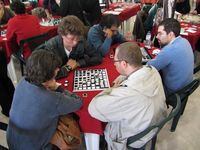
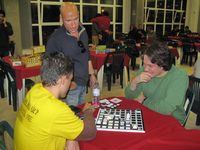
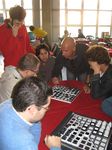
These photos are the property of boardgamegeek.com and do not refer specifically to the edition on this page.




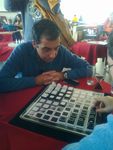
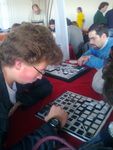
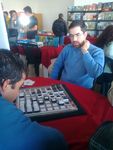
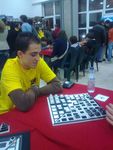
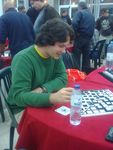
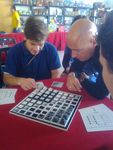

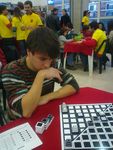
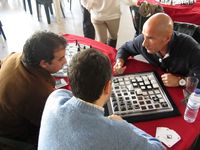
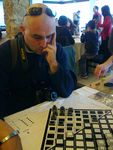

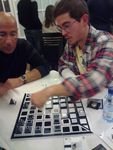
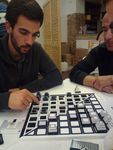
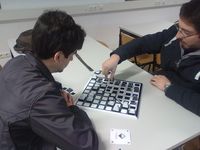
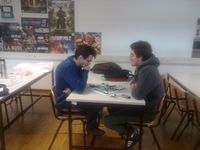




 Description
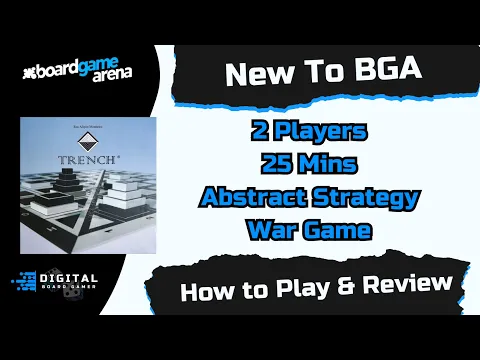
TRENCH abstractly yet poignantly depicts one of the most dramatic military conflicts of the 20th Century: World War I. It stresses the horror, sordidness, and absurdity of life in the trenches, where millions of men were confined for years, including No Man’s Land, the terrain between the two enemy trenches.
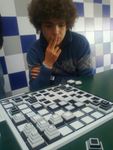
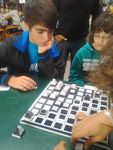
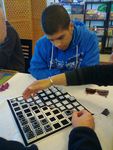
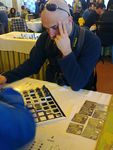
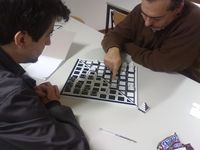
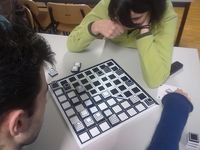
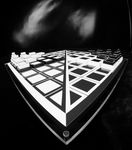
The board, full of geometric abstractionism, 100% in black and white (a humble homage to the typical Portuguese street pavement, Calçada), emphasizing the two horizontal lines suggestive of the Trenches, simulates a battlefield divided into two opposed and well-defined territories. The game pieces, in Cubist style, represent a classic military confrontation, with all the ranks: from the lowly Soldier, to the General atop the pyramid of power.
The algorithm of the game accurately describes the scenario of the "Great War". Its realistic mechanisms reflect the two main periods or phases into which this conventional war is commonly divided:
TRENCH commemorates the War through Art!
About Rules and Game Play:
In this abstract game, imagine that you command a WWI army comprising several ranks, and your pieces are your unit. Obeying very strict but simple mechanisms, every piece in the game has an allowed movement in terms of direction and distance it can move, depending on the rank of the piece, just as in Chess. The goal of the game is to defend your army, and at the same time attack and capture the most valuable pieces from the enemy. After a certain number of confrontations, the player with the highest score wins. You need to maintain a high level of control of the field for this to happen. As for the trenches, the entrenched pieces prevent frontal attacks, causing a high strategic strain on the enemy, who is forced to perform diversion maneuvers and search for other solutions to fight back. Seems easy? It's easier said than done. Its apparently minimalist structure, combined with its fundamental principle of area control, becomes surprisingly hard to master. This is a game that will surely be a challenge, and will not leave you indifferent.
The board, full of geometric abstractionism, 100% in black and white (a humble homage to the typical Portuguese street pavement, Calçada), emphasizing the two horizontal lines suggestive of the Trenches, simulates a battlefield divided into two opposed and well-defined territories. The game pieces, in Cubist style, represent a classic military confrontation, with all the ranks: from the lowly Soldier, to the General atop the pyramid of power.
The algorithm of the game accurately describes the scenario of the "Great War". Its realistic mechanisms reflect the two main periods or phases into which this conventional war is commonly divided:
- War of Movement: The most remarkable feature was the mobilization of the armies and the strategic movement the troops, determined to move forward progressively on the field during constant tactic maneuvers, following a systematic war logic.
- War of Trenches: Reflective of a situation a balance of power, the trenches were effectively the stage of many battles during this conflict, some of which were decisive. The armies were forced to guarantee their positions while preparing to take new territory.
TRENCH commemorates the War through Art!
About Rules and Game Play:
In this abstract game, imagine that you command a WWI army comprising several ranks, and your pieces are your unit. Obeying very strict but simple mechanisms, every piece in the game has an allowed movement in terms of direction and distance it can move, depending on the rank of the piece, just as in Chess. The goal of the game is to defend your army, and at the same time attack and capture the most valuable pieces from the enemy. After a certain number of confrontations, the player with the highest score wins. You need to maintain a high level of control of the field for this to happen. As for the trenches, the entrenched pieces prevent frontal attacks, causing a high strategic strain on the enemy, who is forced to perform diversion maneuvers and search for other solutions to fight back. Seems easy? It's easier said than done. Its apparently minimalist structure, combined with its fundamental principle of area control, becomes surprisingly hard to master. This is a game that will surely be a challenge, and will not leave you indifferent.
 Additional information
| Mechanics: | Point to Point Movement |
| Categories: | Strategy |
| Alternative names: | Classic Wooden Trench Trench Trench - Classic Wooden Edition Trench - Travel Edition Trench: Classic Wooden Edition Trench: Minimalista Edition Trench: Travel Edition Trench: Versailles 1919 |
| BARCODE: | 5600252398112 |
| In 1 wishlist This was seen 16139 times | |
Description
TRENCH abstractly yet poignantly depicts one of the most dramatic military conflicts of the 20th Century: World War I. It stresses the horror, sordidness, and absurdity of life in the trenches, where millions of men were confined for years, including No Man’s Land, the terrain between the two enemy trenches.
The board, full of geometric abstractionism, 100% in black and white (a humble homage to the typical Portuguese street pavement, Calçada), emphasizing the two horizontal lines suggestive of the Trenches, simulates a battlefield divided into two opposed and well-defined territories. The game pieces, in Cubist style, represent a classic military confrontation, with all the ranks: from the lowly Soldier, to the General atop the pyramid of power.
The algorithm of the game accurately describes the scenario of the "Great War". Its realistic mechanisms reflect the two main periods or phases into which this conventional war is commonly divided:
TRENCH commemorates the War through Art!
About Rules and Game Play:
In this abstract game, imagine that you command a WWI army comprising several ranks, and your pieces are your unit. Obeying very strict but simple mechanisms, every piece in the game has an allowed movement in terms of direction and distance it can move, depending on the rank of the piece, just as in Chess. The goal of the game is to defend your army, and at the same time attack and capture the most valuable pieces from the enemy. After a certain number of confrontations, the player with the highest score wins. You need to maintain a high level of control of the field for this to happen. As for the trenches, the entrenched pieces prevent frontal attacks, causing a high strategic strain on the enemy, who is forced to perform diversion maneuvers and search for other solutions to fight back. Seems easy? It's easier said than done. Its apparently minimalist structure, combined with its fundamental principle of area control, becomes surprisingly hard to master. This is a game that will surely be a challenge, and will not leave you indifferent.
The board, full of geometric abstractionism, 100% in black and white (a humble homage to the typical Portuguese street pavement, Calçada), emphasizing the two horizontal lines suggestive of the Trenches, simulates a battlefield divided into two opposed and well-defined territories. The game pieces, in Cubist style, represent a classic military confrontation, with all the ranks: from the lowly Soldier, to the General atop the pyramid of power.
The algorithm of the game accurately describes the scenario of the "Great War". Its realistic mechanisms reflect the two main periods or phases into which this conventional war is commonly divided:
- War of Movement: The most remarkable feature was the mobilization of the armies and the strategic movement the troops, determined to move forward progressively on the field during constant tactic maneuvers, following a systematic war logic.
- War of Trenches: Reflective of a situation a balance of power, the trenches were effectively the stage of many battles during this conflict, some of which were decisive. The armies were forced to guarantee their positions while preparing to take new territory.
TRENCH commemorates the War through Art!
About Rules and Game Play:
In this abstract game, imagine that you command a WWI army comprising several ranks, and your pieces are your unit. Obeying very strict but simple mechanisms, every piece in the game has an allowed movement in terms of direction and distance it can move, depending on the rank of the piece, just as in Chess. The goal of the game is to defend your army, and at the same time attack and capture the most valuable pieces from the enemy. After a certain number of confrontations, the player with the highest score wins. You need to maintain a high level of control of the field for this to happen. As for the trenches, the entrenched pieces prevent frontal attacks, causing a high strategic strain on the enemy, who is forced to perform diversion maneuvers and search for other solutions to fight back. Seems easy? It's easier said than done. Its apparently minimalist structure, combined with its fundamental principle of area control, becomes surprisingly hard to master. This is a game that will surely be a challenge, and will not leave you indifferent.
Additional information
| Mechanics: | Point to Point Movement |
| Categories: | Strategy |
| Alternative names: | Classic Wooden Trench Trench Trench - Classic Wooden Edition Trench - Travel Edition Trench: Classic Wooden Edition Trench: Minimalista Edition Trench: Travel Edition Trench: Versailles 1919 |
| BARCODE: | 5600252398112 |
| In 1 wishlist This was seen 16139 times | |
What players say
How many players it plays best with · 9 votes on BoardGameGeek
- 1 0 0 say it plays best, 0 recommend it, 5 do not recommend it
- 2 9 9 say it plays best, 0 recommend it, 0 do not recommend it
- 2+ 0 0 say it plays best, 0 recommend it, 5 do not recommend it
Best Suggested Not recommended
uplay user ratings: No uplay reviews yet. Be the first!
Your review
Comments are moderated before publication: no links, insults or unrelated content. Respectful negative opinions are welcome.
Sign in to review
CAUTION! Not suitable for children under 3 years of age. It contains small parts which could be swallowed or inhaled.