





A photograph of a perfectly organised box only shows the end result of packing away. To choose a useful insert, you also need to imagine the start of the game: which containers you take out, who receives the components and where the shared pieces stay. If you have to move other trays to reach every resource, neat organisation inside the box may not translate into convenience.
Start with a specific difficulty you have with your game. Do you often mix up similar components? Does everyone have to put their own set of components back together? Does the sleeved deck no longer fit? Inserts address these needs in different ways. For a box you rarely use, labelled bags may be enough; for a campaign you return to frequently, keeping shared components clearly separate from supplies carried over between sessions can be much more useful.
What do you need?
- You own a reprint or a localised edition
- Compare the internal dimensions and components with those specified for the insert, rather than relying on the title alone.
- You have sleeved cards or replacement accessories
- Check the relevant compartments: compatibility with the game does not imply compatibility with every modification.
- You want to get started more quickly
- Look for trays that can go from the box to the table with the components you need already separated.
- You store games vertically
- Check how everything is arranged when the box is closed and how the compartments are protected before assuming that nothing will shift.
The suggestions explained
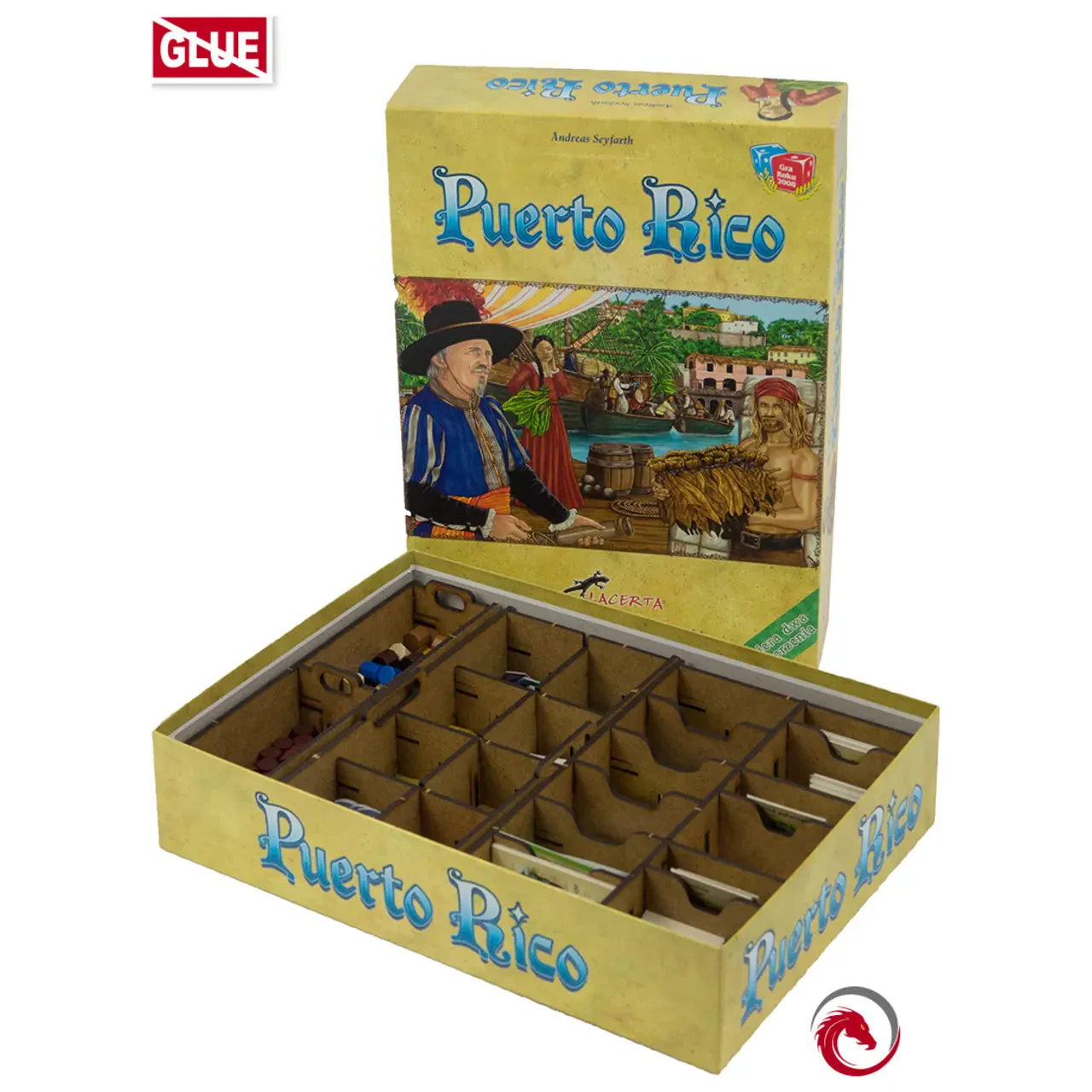
e-Raptor: Puerto Rico Insert
For dividing the components of Puerto Rico between three containers
Edition language: English
See price and buyThe e-Raptor insert for Puerto Rico consists of three separate boxes that can be taken out of the game box. I would consider it if the usual difficulty is finding and distributing buildings, tokens and other pieces: keeping groups of components accessible can reduce the need to transfer them from bags to the table. The listing specifies HDF and glue-free assembly, as well as room for the game board and rulebook.
The trade-off to know
Check your edition of Puerto Rico and the internal dimensions before ordering. The series name does not prove compatibility with reprints or different packaging, nor does it justify assuming that expansions not mentioned in the description can be included.

The Tapestry Organizer from The Broken Token contains 17 removable trays, with dedicated spaces for cards, tiles, buildings and players' sets of components. I would choose it if you want the storage layout to support setup as well: several elements are designed to go from the box to the table already in their own trays. It is an option for people who play Tapestry often and want to organise the components according to how they are used.
The trade-off to know
It is a kit that requires assembly, and the manufacturer recommends wood glue purchased separately. Check which expansions and modifications to your copy you want to accommodate: the product description does not guarantee space for whatever your collection may include in future.

The Takenoko Organizer from The Broken Token has separate trays for bamboo and tiles, containers for tokens and a holder for objective cards. The listing states that there is also room for Chibis and gives assembled dimensions of 270 × 270 × 75 mm. I would consider it when you want the most frequently handled components to be easy to reach and to return to a recognisable place after the game.
The trade-off to know
Measure the internal base of your box: the manufacturer warns that editions and production runs can vary. This is also a kit that requires assembly, with wood glue recommended and sold separately; the game and expansion are not what you are buying.

Black Organizer 7 Wonders Duel
For organising the 7 Wonders Duel box with a slot-together system
See price and buyThe Black Organizer for 7 Wonders Duel is an option to consider if you want to store the components in trays that can also be used on the table. The range description specifies slot-together assembly without glue or screws and compartments that also accommodate sleeved cards. I would choose it after comparing the box you own with the organiser, especially if you pack the game away after every session.
The trade-off to know
The general description of the range does not list every compatible 7 Wonders Duel expansion here. Do not assume it holds everything you own: check the actual configuration and the space available with the sleeves you use for your copy.

The organiser for Cascadia is designed for the larger compartment of the cardboard insert. It provides tile holders, a space for starting tiles and cards, and a tray for nature tokens; the stated assembled dimensions are 11.5 × 23 × 6.5 cm. I would consider it to make the components accessible without blindly replacing the entire storage setup in the box.
The trade-off to know
The listing allows for sleeved cards, but you still need to check the fit with the sleeves you use. Assembly is required, and PVA glue is recommended. Pictures of it in use do not mean that game components or the box are included.

e-Raptor: Great Western Trail Organizer
For keeping the Great Western Trail board stable during play
Edition language: English
See price and buyThe e-Raptor organiser for Great Western Trail keeps discs, cubes and worker tiles in their respective spaces on the player board. The description specifies clear plexiglass and HDF, with the ability to move the board without disturbing the arrangement. I would choose it when the problem is knocking components during play, keeping this function distinct from storage in the box.
The trade-off to know
It is a player-area organiser, not a promise of organised storage for the entire game. Check the edition of the board you own: do not extend the stated compatibility with Great Western Trail to other editions or titles in the same family.
The game family alone does not identify the box
Gloomhaven and Gloomhaven: Jaws of the Lion share a name, but have different contents and packaging. An insert specified for one does not become suitable for the other. The same care is needed with second editions, compact versions and boxes that collect expansions. Look for the full name in the manufacturer's compatibility information, then compare the compartments for the bulkiest components and the decks.
The box dimensions are an initial check, not conclusive proof. The internal spaces, the stack of game boards, any thicker player boards and the card sleeves also matter. If an insert claims to accommodate an expansion, check exactly which one. Images may show components not included with the accessory: you are buying the storage organisation, not the game contents pictured.
Follow the components' journey
To understand whether the design helps you, choose a frequently used resource and follow its journey. Does it have to be taken out of a bag, poured into a bowl and put away again, or can its tray stay on the table? Then try the same with a player's set of components. An insert that keeps everything a player uses together can make setup more straightforward; one that separates pieces only by shape or colour may still require you to distribute everything.
In campaign games, distinguish the archive from the components currently in use. Keeping all the cards neatly stored is not enough if you have to rebuild the character decks from memory at the next session. At the same time, it is useful to avoid exposing content the group has not yet discovered. Assess accessibility and separation, rather than chasing the greatest possible number of compartments.
Assembly, weight and how the box closes are all part of the decision
Before buying, open the assembly instructions when they are available. They show the number of parts, the shape of the trays and the points that need care better than a single photograph. HDF adds a rigid structure and weight to the box: consider whether you transport it often. Assemble it carefully and check the joints as directed in the manual; do not force a game component to fit a compartment.
Assembly instructions vary even between similar inserts: e-Raptor Puerto Rico specifies glue-free assembly; wood glue, sold separately, is recommended for the The Broken Token organisers for Tapestry and Takenoko. Check which materials you need before opening the kit. Finally, check how the top layer is arranged and whether the lid closes in the intended configuration, especially before storing the box vertically.
Questions before buying
Does an insert automatically hold all the expansions?
No. Look for the precise list of compatible expansions. A generic title or a box that looks spacious does not guarantee room for additional content, especially when it introduces boards, miniatures or decks with different card sizes.
Can I use it if I have sleeved my cards?
You need confirmation from the manufacturer and, where possible, a check of the compartment dimensions. Sleeve thickness can change the overall volume. Pay particular attention to decks with the most cards, those that come close to the container's capacity.
Is it worth buying one before the first game?
Before you play, it is harder to know which step you will really find a chore. If compatibility is certain, you can choose one straight away, but an initial play helps you distinguish storage needs from setup needs and avoid compartments that are of little use at your table.
Found your direction?
Explore the product pages to compare editions and choose the one for you.
Explore Accessories