









Language:
Italian


|
|
|
|
3-4
90'
12
Moderate in-game text
|
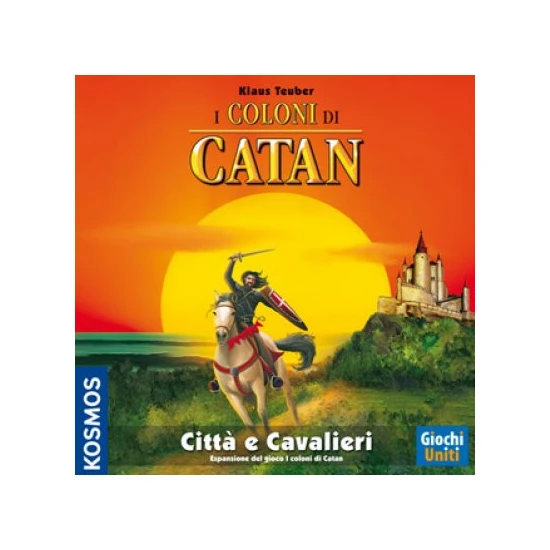
Catan: Città e Cavalieri
In stock in our warehouse
Order by 15:00 Italian time for same-day dispatch, Monday to Friday.
Delivery in Italy normally takes 1 business day, 2 for the islands.
Order by 15:00 Italian time for same-day dispatch, Monday to Friday.
Delivery in Italy normally takes 1 business day, 2 for the islands.
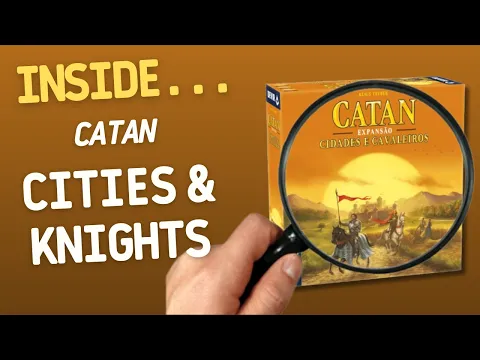
Adds knights to defend against barbarian invaders and city improvements granting benefits. Strategic board game for 3-4 players, 90 minutes duration, ages 12+.
Publisher: Giochi Uniti
 Do you want to sell your copy of this game?

Use our marketplace utrade!
Catan: Città e Cavalieri
Contact us
Share on
 The game game is in consignmentStock but only few copies are available
-20%
29,59€
Sale Price
IT
4,49€
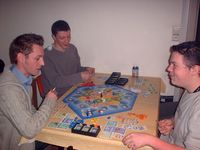
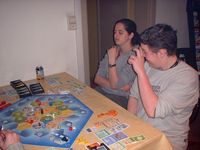
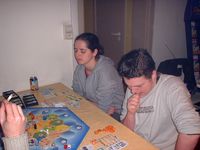
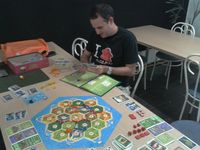
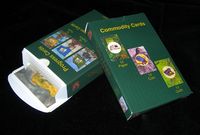
PICTURES ON BGG
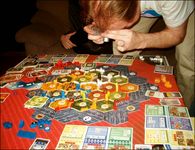
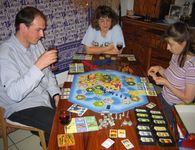
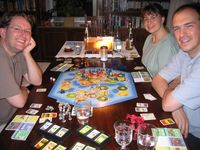
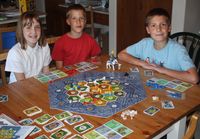
These photos are the property of boardgamegeek.com and do not refer specifically to the edition on this page.










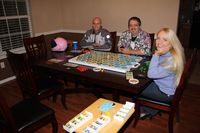




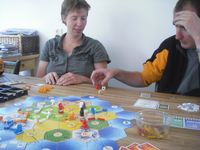


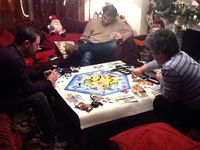



 Description
Adds several new aspects to Settlers of Catan but the two major ones are creating knights to protect the land from invading barbarians and building city improvements that confer benefits upon that city's owner. Adds tactical complexity to the game and game length.
Belongs to the Catan Series.
The game changes the base game in three main ways:
First, there are 3 new commodities in the game, distinct from resources - paper, cloth, and coins, which can be acquired from Forest, Meadow, and Mountain spaces, respectively. Cities that would normally produce two of one of those resources instead produce 1 resource and 1 of the corresponding commodity. (To make commodities easier to obtain, each player starts the game with 1 city and 1 settlement on the board.) These commodities allow players to build city improvements that confer various advantages and eventually points.
Second, the deck of development cards is replaced by three different decks, each corresponding to one of the commodities. Building city improvements gives players a chance to draw these cards with every roll of the dice. Building more improvements will increase these chances, but cards cannot be bought directly in any way. These cards are similar to the development cards in the base game, but with a wider range of effects. (Some cards are balanced better as well - the new Resource Monopoly card, for example, can take no more than 2 of the named resource from any one player.)
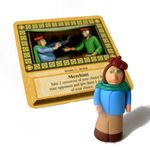
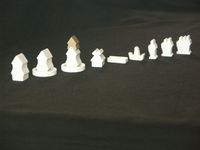
Finally, players can also build knights on the island along their network of roads. These knights can be used to claim certain intersections and move the Robber (taking the place of Soldier cards), but are also used to defend the island from periodic barbarian attacks. If the island is successfully defended, the player(s) with the most knights are rewarded. If not, the player(s) with the fewest knights each have a city downgraded to a settlement.
Belongs to the Catan Series.
The game changes the base game in three main ways:
First, there are 3 new commodities in the game, distinct from resources - paper, cloth, and coins, which can be acquired from Forest, Meadow, and Mountain spaces, respectively. Cities that would normally produce two of one of those resources instead produce 1 resource and 1 of the corresponding commodity. (To make commodities easier to obtain, each player starts the game with 1 city and 1 settlement on the board.) These commodities allow players to build city improvements that confer various advantages and eventually points.
Second, the deck of development cards is replaced by three different decks, each corresponding to one of the commodities. Building city improvements gives players a chance to draw these cards with every roll of the dice. Building more improvements will increase these chances, but cards cannot be bought directly in any way. These cards are similar to the development cards in the base game, but with a wider range of effects. (Some cards are balanced better as well - the new Resource Monopoly card, for example, can take no more than 2 of the named resource from any one player.)
Finally, players can also build knights on the island along their network of roads. These knights can be used to claim certain intersections and move the Robber (taking the place of Soldier cards), but are also used to defend the island from periodic barbarian attacks. If the island is successfully defended, the player(s) with the most knights are rewarded. If not, the player(s) with the fewest knights each have a city downgraded to a settlement.
 Additional information
| Mechanics: | Dice Rolling Memory Trading Modular Board Hand Management Costruzione reti e percorsi |
| Categories: | Medieval Expansion for base-game Negoziazione |
| Alternative names: | |
| BARCODE: | 8059386296486 |
| The item is in 10 carts In 1 wishlist This was seen 2825 times | |
Description
Adds several new aspects to Settlers of Catan but the two major ones are creating knights to protect the land from invading barbarians and building city improvements that confer benefits upon that city's owner. Adds tactical complexity to the game and game length.
Belongs to the Catan Series.
The game changes the base game in three main ways:
First, there are 3 new commodities in the game, distinct from resources - paper, cloth, and coins, which can be acquired from Forest, Meadow, and Mountain spaces, respectively. Cities that would normally produce two of one of those resources instead produce 1 resource and 1 of the corresponding commodity. (To make commodities easier to obtain, each player starts the game with 1 city and 1 settlement on the board.) These commodities allow players to build city improvements that confer various advantages and eventually points.
Second, the deck of development cards is replaced by three different decks, each corresponding to one of the commodities. Building city improvements gives players a chance to draw these cards with every roll of the dice. Building more improvements will increase these chances, but cards cannot be bought directly in any way. These cards are similar to the development cards in the base game, but with a wider range of effects. (Some cards are balanced better as well - the new Resource Monopoly card, for example, can take no more than 2 of the named resource from any one player.)
Finally, players can also build knights on the island along their network of roads. These knights can be used to claim certain intersections and move the Robber (taking the place of Soldier cards), but are also used to defend the island from periodic barbarian attacks. If the island is successfully defended, the player(s) with the most knights are rewarded. If not, the player(s) with the fewest knights each have a city downgraded to a settlement.
Belongs to the Catan Series.
The game changes the base game in three main ways:
First, there are 3 new commodities in the game, distinct from resources - paper, cloth, and coins, which can be acquired from Forest, Meadow, and Mountain spaces, respectively. Cities that would normally produce two of one of those resources instead produce 1 resource and 1 of the corresponding commodity. (To make commodities easier to obtain, each player starts the game with 1 city and 1 settlement on the board.) These commodities allow players to build city improvements that confer various advantages and eventually points.
Second, the deck of development cards is replaced by three different decks, each corresponding to one of the commodities. Building city improvements gives players a chance to draw these cards with every roll of the dice. Building more improvements will increase these chances, but cards cannot be bought directly in any way. These cards are similar to the development cards in the base game, but with a wider range of effects. (Some cards are balanced better as well - the new Resource Monopoly card, for example, can take no more than 2 of the named resource from any one player.)
Finally, players can also build knights on the island along their network of roads. These knights can be used to claim certain intersections and move the Robber (taking the place of Soldier cards), but are also used to defend the island from periodic barbarian attacks. If the island is successfully defended, the player(s) with the most knights are rewarded. If not, the player(s) with the fewest knights each have a city downgraded to a settlement.
Additional information
| Mechanics: | Dice Rolling Memory Trading Modular Board Hand Management Costruzione reti e percorsi |
| Categories: | Medieval Expansion for base-game Negoziazione |
| Alternative names: | |
| BARCODE: | 8059386296486 |
| The item is in 10 carts In 1 wishlist This was seen 2825 times | |
 Frequently bought together







What players say
How many players it plays best with · 186 votes on BoardGameGeek
- 1 0 0 say it plays best, 0 recommend it, 139 do not recommend it
- 2 5 5 say it plays best, 19 recommend it, 125 do not recommend it
- 3 85 85 say it plays best, 85 recommend it, 6 do not recommend it
- 4 121 121 say it plays best, 49 recommend it, 6 do not recommend it
- 4+ 8 8 say it plays best, 13 recommend it, 101 do not recommend it
Best Suggested Not recommended
uplay user ratings: No uplay reviews yet. Be the first!
Your review
Comments are moderated before publication: no links, insults or unrelated content. Respectful negative opinions are welcome.
Sign in to review
CAUTION! Not suitable for children under 3 years of age. It contains small parts which could be swallowed or inhaled.