









Language:
German


|
|
|
|
|
Decorum
Publisher: Skellig Games
 Do you want to sell your copy of this game?

Use our marketplace utrade!
Decorum
Contact us
Share on
 Available in an external warehouse.
Shipping in about 3/7 days
-15%
47,56€
Sale Price
IT
Free
PICTURES ON BGG
These photos are the property of boardgamegeek.com and do not refer specifically to the edition on this page.
























 Description
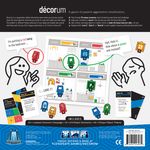
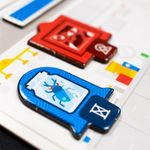
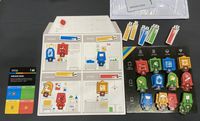
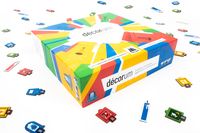
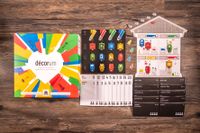
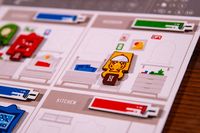
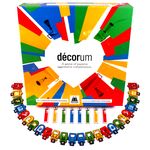
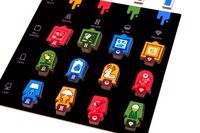
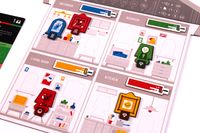
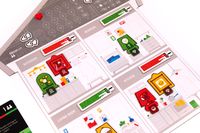
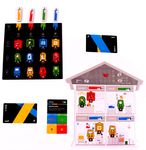
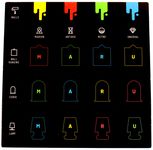
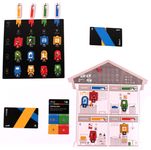
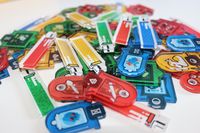
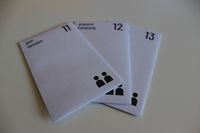
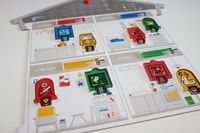
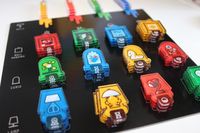
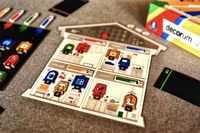
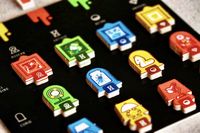
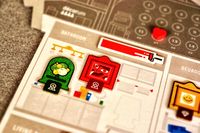
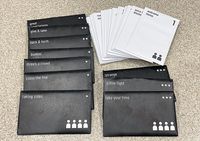
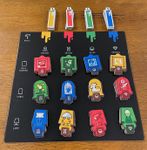
Decorum is a cooperative hidden-information game where you and your partner share the same goal: to decorate your house so that you are both happy. The problem is that each of you is happy with different things, and no one says exactly what they need. Can you find a compromise, or is it time to move out? Play 30 unique scenarios, each bringing new twists and challenges. Keep your conditions secret, which indicate how you want the house decorated. Add objects, remove them, swap them out, or repaint rooms to make the house look exactly as you envision it. Respond with "I love it", "I hate it", or "I think it's good" to work together towards a perfectly decorated house. For each scenario, there is a solution; the trick is to figure it out in time. Essentially, Décorum is a fairly simple logic puzzle. There are a limited number of ways to arrange the furnishings so that all the requirements listed on the players' rule sheets are met simultaneously. The twist in Décorum is that it is also a hidden-information game. No player knows all the rules. During the game, players must observe their partner's moves as carefully as they plan their own. Even more crucially, they must communicate - with the very limited means the game provides - why they are making the moves they make. While Décorum is about solving a puzzle, it is really a game about communication and compromise. The real challenge is not just solving the problem with the limited information you and your fellow players have, but dealing with the frustrations that inevitably arise when your partner does something that disrupts your plan. To succeed in Décorum, both players must, at some point, abandon their original strategy for how they wanted to finish the board and instead pay attention to what their partner is doing. By introducing and incentivizing conflict resolution, Décorum mechanically promotes (or requires) a positive form of compromise.
 Additional information
| Mechanics: | |
| Categories: | |
| Alternative names: | |
| BARCODE: | 725765192349 |
| In 1 collection This was seen 1053 times | |
Description
Decorum is a cooperative hidden-information game where you and your partner share the same goal: to decorate your house so that you are both happy. The problem is that each of you is happy with different things, and no one says exactly what they need. Can you find a compromise, or is it time to move out? Play 30 unique scenarios, each bringing new twists and challenges. Keep your conditions secret, which indicate how you want the house decorated. Add objects, remove them, swap them out, or repaint rooms to make the house look exactly as you envision it. Respond with "I love it", "I hate it", or "I think it's good" to work together towards a perfectly decorated house. For each scenario, there is a solution; the trick is to figure it out in time. Essentially, Décorum is a fairly simple logic puzzle. There are a limited number of ways to arrange the furnishings so that all the requirements listed on the players' rule sheets are met simultaneously. The twist in Décorum is that it is also a hidden-information game. No player knows all the rules. During the game, players must observe their partner's moves as carefully as they plan their own. Even more crucially, they must communicate - with the very limited means the game provides - why they are making the moves they make. While Décorum is about solving a puzzle, it is really a game about communication and compromise. The real challenge is not just solving the problem with the limited information you and your fellow players have, but dealing with the frustrations that inevitably arise when your partner does something that disrupts your plan. To succeed in Décorum, both players must, at some point, abandon their original strategy for how they wanted to finish the board and instead pay attention to what their partner is doing. By introducing and incentivizing conflict resolution, Décorum mechanically promotes (or requires) a positive form of compromise.
Additional information
| Mechanics: | |
| Categories: | |
| Alternative names: | |
| BARCODE: | 725765192349 |
| In 1 collection This was seen 1053 times | |
 Other versions
What players say
uplay user ratings: No uplay reviews yet. Be the first!
Your review
Comments are moderated before publication: no links, insults or unrelated content. Respectful negative opinions are welcome.
Sign in to review
CAUTION! Not suitable for children under 3 years of age. It contains small parts which could be swallowed or inhaled.