





With eight or more people, the real bottleneck is often attention. Everyone can be sitting at the table while only three people take part in the discussion. That is why I would start with the kind of contribution the game offers each person: a personal answer, a vote, an accusation to defend. The maximum player count on the box must be respected, but it does not guarantee the experience you want on its own.
Top Ten is a choice for a group that wants to invent and listen, Avalon for those who enjoy suspicion and argument, and Lupus in Tabula for a larger group willing to follow a moderator. Comparing them requires precision: in Lupus, becoming a ghost does not mean disappearing from the game completely, but it significantly changes how you are allowed to take part.
What do you need?
- There are four to nine of you, and you enjoy creative answers
- Top Ten gives each player an individual prompt, with the response to be placed on a shared scale.
- There are five to ten of you, and you enjoy discussing whom to trust
- Avalon builds tension around hidden identities and incomplete information.
- There are more than ten of you, and you have someone willing to moderate
- Lupus in Tabula is a relevant choice, provided you explain the ghosts’ reduced role beforehand.
- Someone hates being accused or having to lie
- Choose Top Ten if they enjoy expressing themselves, rather than insisting on social deduction.
The suggestions explained

I would choose Top Ten for a group that enjoys listening to brief creative answers and comparing how extreme they are. Each answer must suggest the intensity of the secret number, so the best joke is not necessarily the loudest: it needs to make sense in relation to the others. Cooperation shifts the focus from outdoing a friend to understanding one another. It is particularly relevant when you want to be part of the same conversation and are comfortable with a personal moment in the spotlight. The nine-player variant gives the captain only the task of ranking the eight answers, a detail to explain before you start.
The trade-off to know
Inventing an answer, and miming it for some prompts, can make anyone who does not want to perform uncomfortable. I would not present it as automatically suitable for reserved people. Nine is also the stated limit, not a starting point to extend by handing out duplicate numbers; larger groups need another solution.

The Resistance: Avalon (Edizione 2022)
For those who want to defend hypotheses and read intentions
Edition language: Italian
See price and buyAvalon is an option for friends who enjoy discussing trust, ambiguity and possible double-dealing. Information is not distributed equally, and Merlin must manage what he knows without revealing too much: a statement may have reasons behind it other than those that seem apparent. I would choose it when the group wants to focus on the game’s conversation and accepts bluffing as part of the fun. The game is standalone and supports five to ten players. It does not require you to own The Resistance, despite the connection reflected in the title, so it can be a complete starting point.
The trade-off to know
Social deduction requires listening and a willingness to be contradicted. It is not a simple filler while half the group talks about something else. If someone dislikes lying or being suspected, I would prefer Top Ten for a creative group, or two tables with different activities.

Lupus in Tabula
For a large group with someone who knows how to moderate
Edition language: Italian, English
See price and buyLupus in Tabula is the most targeted option when the group exceeds the limits of the other two boxes and wants a collective discussion involving secret identities. The moderator organises night, day and voting, and that guidance is part of the experience. I would choose it for a group that wants to focus on the game and understands the change of role after a character dies. Ghosts retain a form of voting, but not the ability to contribute verbally. Knowing this distinction in advance lets everyone decide whether the format matches the evening they want.
The trade-off to know
Anyone eliminated early may spend a long time without speaking, even though they retain limited influence. I would not choose it when the aim is free conversation involving everyone throughout the evening. With up to ten people, I would consider Avalon; otherwise, I would consider two groups rather than adding improvised roles.
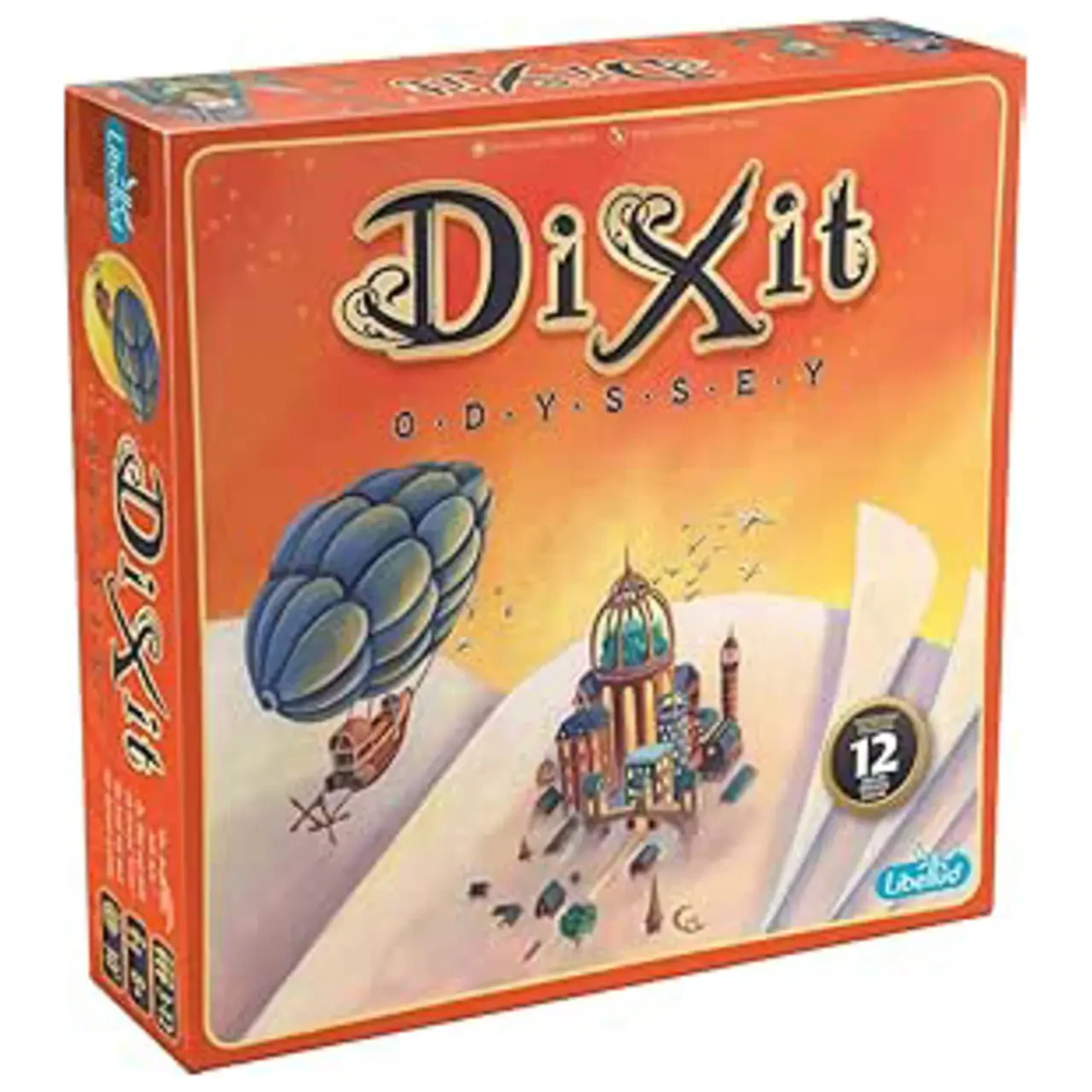
Dixit Odyssey
For a group of up to twelve that enjoys interpreting images
Edition language: Italian
See price and buyDixit Odyssey lets you present a card through a word or description, leaving the others to choose compatible images and identify the correct one. I would consider it for a large group that prefers evocative associations to suspicion about secret roles. This box is described as standalone and contains components for up to twelve players: it should not be confused with a simple pack of extra cards for Dixit.
The trade-off to know
Someone still has to invent a description, and the others have to interpret it. I would therefore not present it as free from personal exposure or automatically suitable for mixed-language groups; a large table must also allow everyone to see the cards.
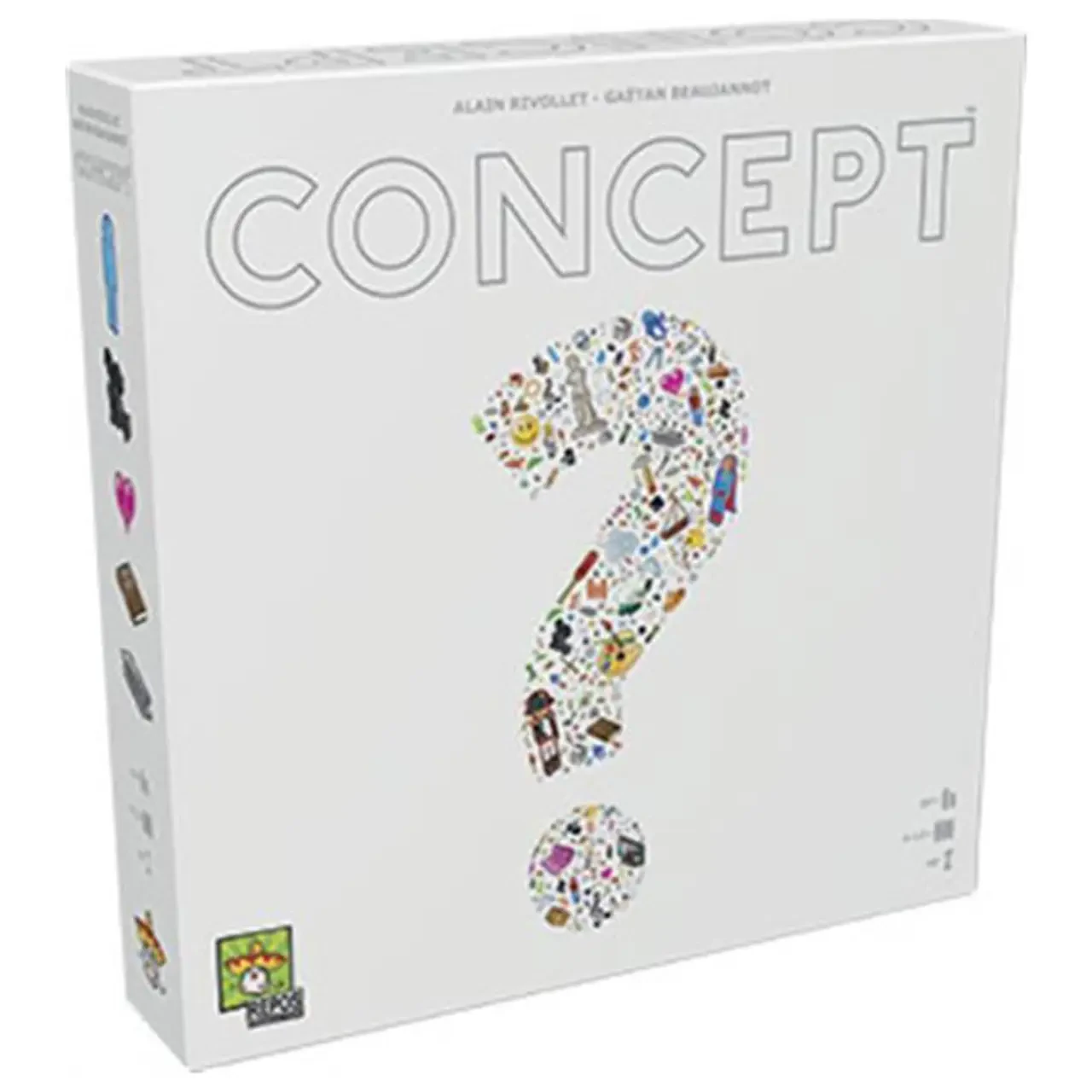
Concept shares out the task differently: two people choose a word or phrase and try to convey it by selecting icons on the board. I would suggest it to anyone who wants a shared activity without asking one person to act or draw in front of the others. The listing specifies four to twelve players, and the game centres on paying attention to a shared visual clue, with a clear objective even for those who are listening more than contributing.
The trade-off to know
Taking part requires a clear view of the board and a shared vocabulary for the answers. Icons do not remove the difficulty of getting others to guess a phrase; if some players would rather choose cards for themselves, I would look at Sushi Go Party! for up to eight people.

Nome in Codice XXL
For teams that want to discuss word associations
Edition language: Italian
See price and buyNome in Codice XXL gives team leaders the task of creating clues and everyone else the task of discussing possible connections between the visible words. I would choose it when a large group wants to reason together rather than wait for an individual challenge. The XXL version is described as having larger components, a concrete factor to consider when reading from the opposite side of the table. The Italian listing specifies up to twelve players.
The trade-off to know
A shared vocabulary remains essential, and someone may want to guess without taking on the team leader’s role. Choosing the assassin also ends the game for that team: this is a risk to explain beforehand, not leave first-time players to discover for themselves.

Sushi Go Party!
For a table of up to eight that wants individual choices
Edition language: Italian
See price and buySushi Go Party! is an option for a group that prefers building card combinations to inventing jokes or backing up an accusation. Before the game, you choose the menu, then try to assemble a useful scoring combination over three rounds: this preparation also provides an opportunity to agree on what everyone will need to understand. I would pick it for a group of two to eight people, explicitly distinguishing it from Sushi Go!, which accommodates up to five.
The trade-off to know
Eight is the stated limit: I would not adapt it by adding places to accommodate a table of ten. Choosing the menu and understanding its scoring requires attention before you begin, so this is not the same proposition as a single prompt that can be explained while everyone is talking.
Eight, nine and ten are not the same setup
Top Ten has a concrete difference at nine players: the captain does not receive a number or invent an answer of their own, but ranks those of the other eight players. This is a solution to participation set out in the rules, not an invitation to add unlimited players. With eight players, the captain also gives an answer; knowing this distinction avoids discovering at the table that the components do not support the procedure you had in mind.
Avalon accommodates up to ten players. Adding people changes the number of voices and the number of relationships to observe: there is no reason to assume that the maximum player count is always the best setup for a new group. A first game with people who listen and explain their choices can be more engaging than a full table where only those who already know the game lead every discussion.
Suspicion should lead to reasoning, not putting people on trial
Avalon gives the two sides different information and makes Merlin’s role delicate: he knows something but cannot make himself too easy to identify. This tension raises an interesting question: is someone making a mistake, hiding something or trying to guide the others without revealing themselves? I would suggest this kind of reading of intentions to those who enjoy ambiguity, not those who demand firm proof before making a choice.
For the group to work well, observations should refer to decisions made during the game. “Earlier you supported that group, now you’re rejecting it” opens up a discussion; “you always lie” shuts it down and brings something personal to the table. You do not need to act to take part, but you do need to accept that your statements will be questioned. A creative cooperative game can be much more suitable if not everyone is comfortable with that understanding.
Lupus: explain the ghosts before the first night
Under the Lupus in Tabula rules consulted, anyone who becomes a ghost can no longer speak and loses their character’s abilities. They retain their vote to choose the suspects, but do not take part in the subsequent decision about who is lynched. Simply saying “no one is excluded” would therefore be misleading: they still have a way to influence events, but their part in the evening’s conversation is over.
A very large group also needs someone willing to moderate, prepare the roles and run the phases in an orderly way. The moderator’s role should be considered separately from the character count; the rules also offer a specific eight-player variant without a moderator. If no one is willing to take this on, or everyone wants to keep speaking until the end, splitting the group between two tables can be more inclusive than forcing everyone into a single game.
Questions before buying
There are nine of us: does Top Ten need a made-up rule?
No. The rules provide a specific mode: the captain ranks the other eight players’ answers and does not give an answer of their own.
Do eliminated players keep playing in Lupus in Tabula?
In the edition with ghosts consulted, they retain their vote for the suspects, but no longer speak, use abilities or vote on the lynching. Their participation changes substantially.
Is a twenty-player game better, or two tables?
It depends on the kind of participation you want. Two tables can offer more opportunities to decide and speak; a single group works if everyone accepts the timing and moderation required.
Found your direction?
Explore the product pages to compare editions and choose the one for you.
Explore Party games